Training scale: from rhythm to collection — a practical guide

At a glance
- The training scale is not a theoretical construct but the most important toolbox of classical dressage training — anyone who does not understand it rides like someone navigating without a map.
- The six stages of rhythm, suppleness, contact, impulsion, straightness and collection build on one another but also overlap — a stage is rarely 'finished' but is confirmed again at each higher level.
- At Eichhof Akademie we work with the scale in every riding session — from loosening through trot work to collection at the end. Anyone who uses the six points as a daily checklist progresses faster and more safely.
The training scale is the most important tool of classical dressage training. It describes in six building stages how a horse is trained from raw beginner to a collected-working sport horse — and it explains why some horses ride Advanced (S) level with ease while others stagnate already at Elementary (L) level.
Anyone who does not understand the scale rides like someone navigating without a map. Anyone who understands it has a daily checklist for every riding lesson — from starting under saddle to Grand Prix. In this article we explain the six stages step by step with concrete trainer examples from practice at Eichhof Akademie.
The training scale at a glance
The six stages of the classical FN training scale, from bottom to top:
- Rhythm — the even tempo in walk, trot and canter
- Suppleness — the inner and outer relaxation of the horse
- Contact — the calm, trusting connection from horse’s mouth to rider’s hand
- Impulsion — the energy carrying forward in the movement
- Straightness — the even stepping of the hind legs in the track of the forelegs
- Collection — the taking on of weight by the hindquarters with uprightness of the forehand
This sequence is not coincidence but a logical building order. Each stage presupposes the previous one. The scale is thus the foundation of the classical German school of riding — how this path differs from classical-baroque riding art is explained in our post Classical dressage vs. classical-baroque riding art.
Stage 1 — Rhythm
Rhythm is the even tempo of the movement. Walk has a pure four-beat (four distinguishable hoof beats), trot a two-beat (diagonal leg pairs simultaneously), canter a three-beat (three distinguishable hoof beats, followed by a brief moment of suspension).
What happens with rhythmic movement: the horse moves mechanically correctly, without tension in the movement. What happens with unrhythmic movement: the horse rushes in trot, paces in walk, makes a four-beat canter — hints at tension, lameness or rider mistakes.
Practical example: When a young horse paces in walk in the first weeks after starting under saddle, it is almost always a sign of tension. Release it with quiet walk on a long rein, without pressure — rhythm comes with trust.
Stage 2 — Suppleness
Suppleness is the inner and outer relaxation of the horse. It shows in five features:
- Tail swing freely with the movement
- Chewing with satisfied mouth
- Snorting in walk and trot
- Swinging back
- Attentive, moving ears
A supple horse lets the aids ‘come through’ — rider impulses are taken up by the back, conducted through the body, answered. A tense horse blocks: the back becomes fixed, the shoulders pulled up, the mouth braced against the hand.
Practical example: The loosening phase of a riding lesson should last 15 to 20 minutes. Walk on a long rein, quiet trot in large lines, quietly leading canter. Anyone who skips this phase builds the rest of the lesson on a tense horse — and then wonders why the figures don’t work.
Stage 3 — Contact
Contact is the calm, trusting connection from horse’s mouth to rider’s hand. The horse seeks and holds contact to the hand, without bracing against the rein and without coming behind the rein.
Three preconditions are needed:
- Rhythm and suppleness — without these no honest contact
- Hindquarter activity — the horse pushes from behind into the hand
- Calm, soft rider hand — no pulling, no fidgeting hand
Practical example: When a horse comes behind the rein (nose to chest), it often has no contact problems but push problems from the hindquarters — or the rider hand is too strong. Don’t solve it by pulling but by riding from back to front, calmly, with honest hand.
Stage 4 — Impulsion
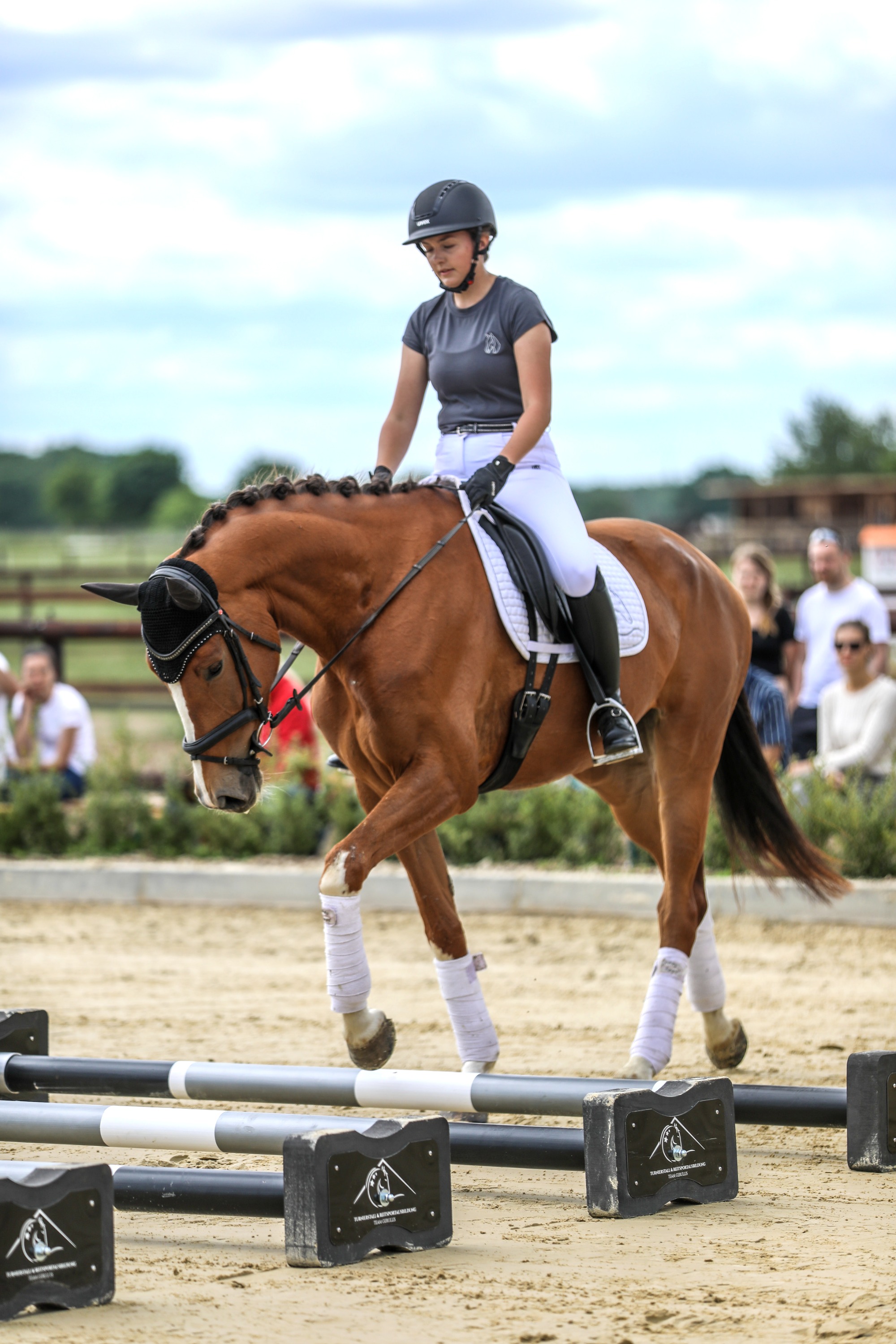
Impulsion is the energy carrying forward in the movement. An impulsive horse cushions the rider’s movement elegantly, the back works actively, the hindquarters push energetically and elastically.
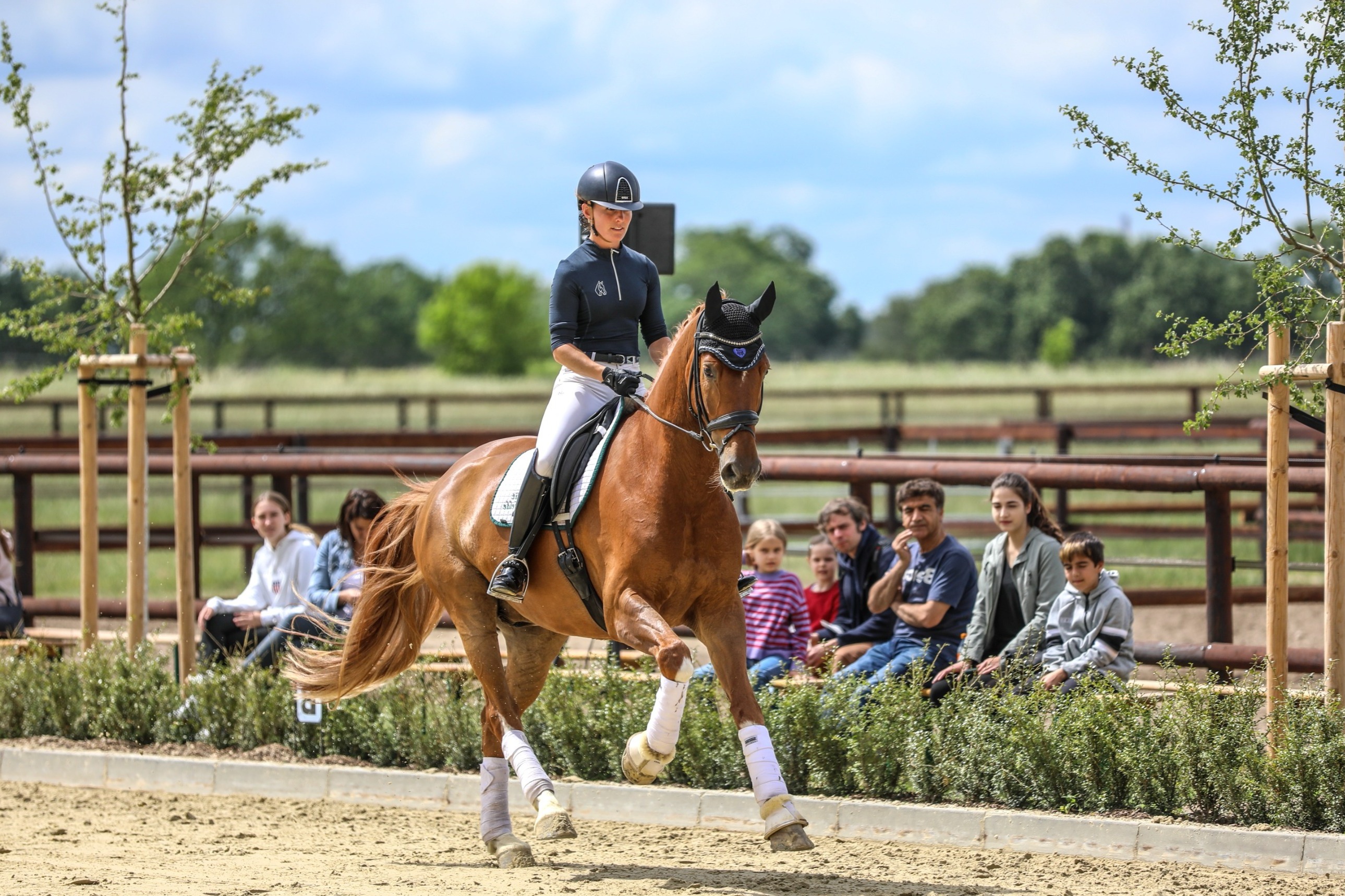
Impulsion is not to be confused with speed. A horse running fast does not automatically have impulsion — often it just has hurry. Real impulsion shows in the moment of suspension (visible in trot and canter), in which the horse ‘flies’ before the next leg pair touches down.
Practical example: Trot-walk-trot transitions develop impulsion. When the horse comes up in front in the transition to trot and trots off with energy, impulsion comes. When it trots off sluggishly, hindquarter activity is missing.
Stage 5 — Straightness
Straightness means that the hind legs step in the track of the forelegs — on straight lines as well as on curved ones. Horses are by nature ‘crooked’: most have a preferred side, a hollow and a stiff side.
Straightness is the most laborious stage of the scale because it requires much detail and repetition work. Shoulder-fore, shoulder-in, travers, renvers — these lessons are straightness work. They distribute weight evenly across all four legs and prevent one-sided loading.
Practical example: A common test: ride a straight line without help from the wall. Does the hind leg step into the track of the foreleg, or does it deviate inward or outward? Asymmetries in straightness are a clear sign of necessary corrective work — often also on the rider, whose one-sided seat makes the horse crooked.
Stage 6 — Collection
Collection is the taking on of weight by the hindquarters. The horse sets the hind legs significantly further under the centre of gravity, raises the forehand, becomes shorter and higher in silhouette.
Collection is the crown of classical dressage training and the foundation of all high figures — piaffe, passage, pirouette, flying changes. Real collection never comes from the rider’s hand (that would be ‘pulled together’) but from the push of the hindquarters with simultaneous acceptance through a steady, soft hand.
Practical example: Extended trot and trotting off from half halts train collection. When the horse takes the hindquarters under itself and becomes lighter in front in the transition, real collection comes. When it just becomes shorter and slower without lifting the forehand, it is only ‘held’ — not real collection.
How we work daily with the scale at Eichhof Akademie
In each of our riding sessions we work according to this principle:
- 15-20 minutes loosening — walk on a long rein, quiet trot, quiet canter. Goal: rhythm and suppleness.
- 20-25 minutes main work — figures for the respective class, always with an eye on contact and impulsion.
- 10 minutes collected work — depending on level, half halts, transitions, figures from the next-higher class.
- 10 minutes closing phase — on a long rein at walk, quiet cooling down.
This structure is not rigid but helps connect every lesson to the scale. More on our training philosophy and our trainers on the website.
When you need a trainer
The training scale can be learned with good books — but riding is not learned from books. You need a trainer who sees from outside what you cannot feel in the saddle. And you need the mirror through clinics with experienced trainers that can address your concrete horse situation.
If you are considering working with us — as a boarder with a riding-lesson package or as an outside clinic participant — contact us. We take time for an initial conversation and check whether our methodology fits.
The training scale at a glance
| Stage | What it means | Common mistake |
|---|---|---|
| Rhythm | Even tempo in walk, trot, canter | Pacing walk, four-beat canter |
| Suppleness | Inner and outer relaxation | Tense back, fixed mouth |
| Contact | Trusting connection horse-mouth to rider-hand | Behind the rein, against the hand |
| Impulsion | Energy carrying forward | Confusion with speed |
| Straightness | Hind legs in the track of the forelegs | Crooked horse, uneven loading |
| Collection | Taking weight on hindquarters | Holding instead of real acceptance |
Further reading
- FN — Training scale (official page, in German) — the official definition of the six points of the FN training scale
- FN — In-depth article on collection (in German) — detailed article with concrete exercises
- FN — In-depth article on contact (in German) — the most common source of error in practice
- FN-Verlag — Guidelines Volumes 1 & 2 (in German) — the official standard work of German riding theory
- Spanish Riding School Vienna — Europe’s oldest riding institution, UNESCO heritage, codified tradition of the high school
Written by Franziska Gutsche, owner of Eichhof Akademie and regional representative of the Gesellschaft für Xenophon. At Eichhof Akademie we work daily to the FN training scale — both in lessons for our boarders and in professional schooling of young and established sport horses.
Questions & Answers