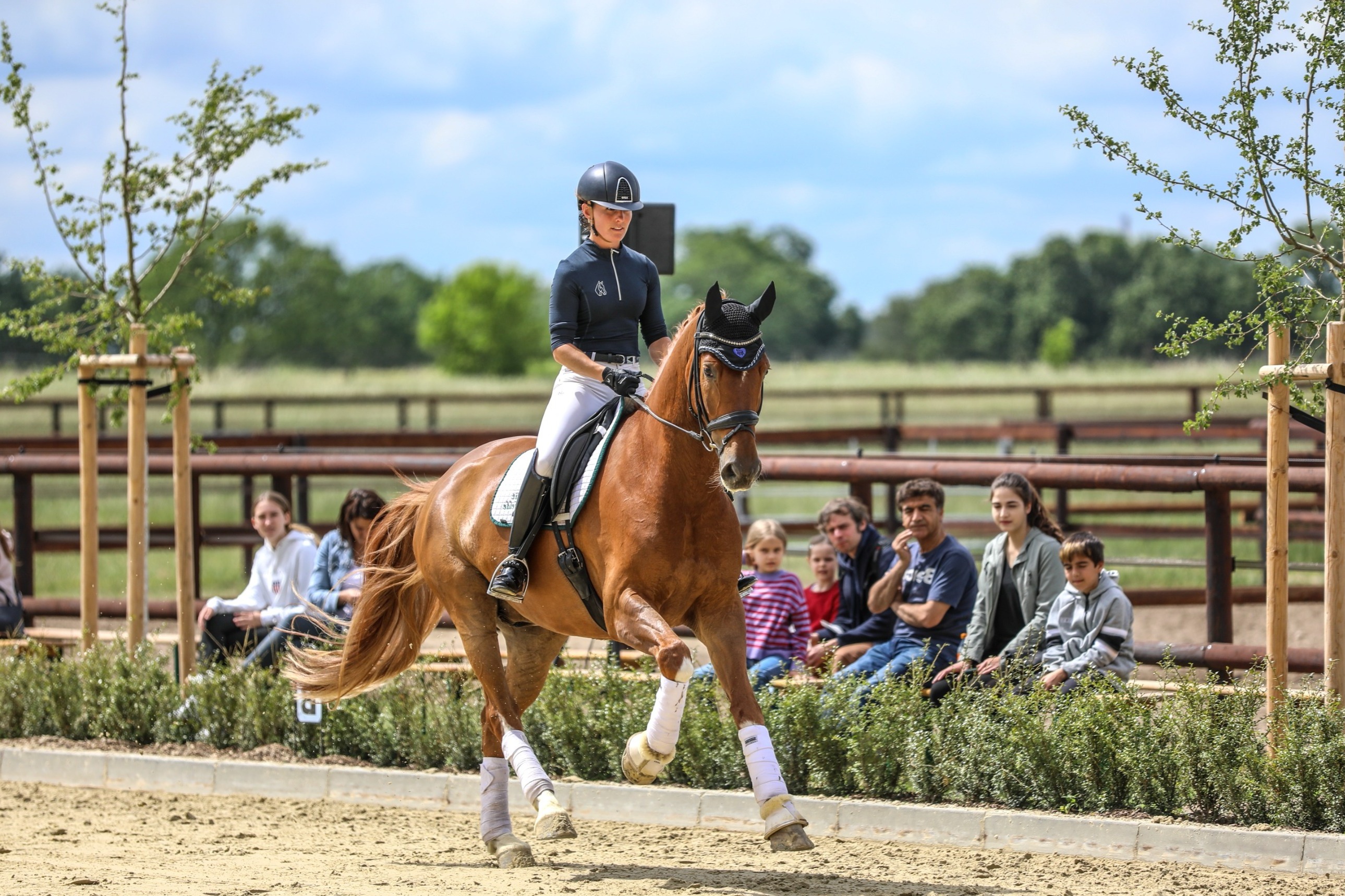
From Novice (A) to Advanced (S): realistic roadmap for dressage training

At a glance
- The path from Novice (A) to Advanced (S) takes a talented horse-rider pair realistically six to eight years — without shortcuts, with the right trainer and consistent building work to the training scale.
- The biggest pitfalls lie not in the higher figures but in the consistency of the foundations: anyone who does not yet have reliable contact at Elementary (L) level will fail at collection at Medium (M).
- Realistic monthly training costs for ambitious amateur dressage sport in 2026 range from 1,000 to 2,500 euros — boarding, lessons, clinics, farrier, vet, competitions combined.
The roadmap from Novice (A) to Advanced (S) is one of the most honest stories one can tell in dressage sport. It is not the story of a linear rise but the story of slow, repetitive building work, with occasional breakthroughs and many setbacks. Anyone who understands this walks the path with realistic expectations — and goes further than someone seeking a ‘fast track’.
In this article we trace the realistic path from Novice (A) to Advanced (S): which time windows are realistic, which content is trained in which class, which pitfalls are typical, and what does the path cost over the years? We write from the practice of a sport riding facility that regularly accompanies riders and horses on this path.
What the classes mean
The German FN distinguishes six classes in dressage sport:
- Class E — Entry level (competition format for riders from riding badge)
- Class A — Novice level: tasks in the forward-contact range
- Class L — Elementary level: impulsion and beginning straightness
- Class M — Medium level: collection beginning, simple pirouettes
- Class S — Advanced level: collection, high figures, flying changes
- Grand Prix (S**)** — top sport with piaffe, passage, flying-change tour
Between the classes there are two stages each (Class A* and A**, L* and L**, M* and M**), which enable gradual building. Class S itself is finely graded and ranges from S* (Prix St. Georg) through S** (Intermédiaire I) and S*** (Intermédiaire II) to S**** (Grand Prix).
Every class has clear requirements, codified in the tasks of the respective test. Anyone starting Elementary must master all figures from Novice plus the new requirements from Elementary. There are no shortcuts. This path follows the classical FN school of riding — how it differs from classical-baroque riding art is shown in our comparison Classical dressage vs. classical-baroque riding art.
Phase 1 — Class E and A (Years 1-2)
Training content: Build solid foundations. Rhythm in all three basic gaits, beginning suppleness, simple contact, transitions between gaits, simple turns, simple track figures (circle, serpentine, volte).
Hours per week: Three to five riding lessons, ideally two with a trainer.
Realistic time to level: One to two years for riders who can already ride and have a horse trained at this level. For beginners or raw horses longer.
Typical pitfalls: Working toward higher tasks too early. Not correcting seat mistakes. Letting the horse rush in canter without consolidating contact.
Phase 2 — Class L (Years 2-4)
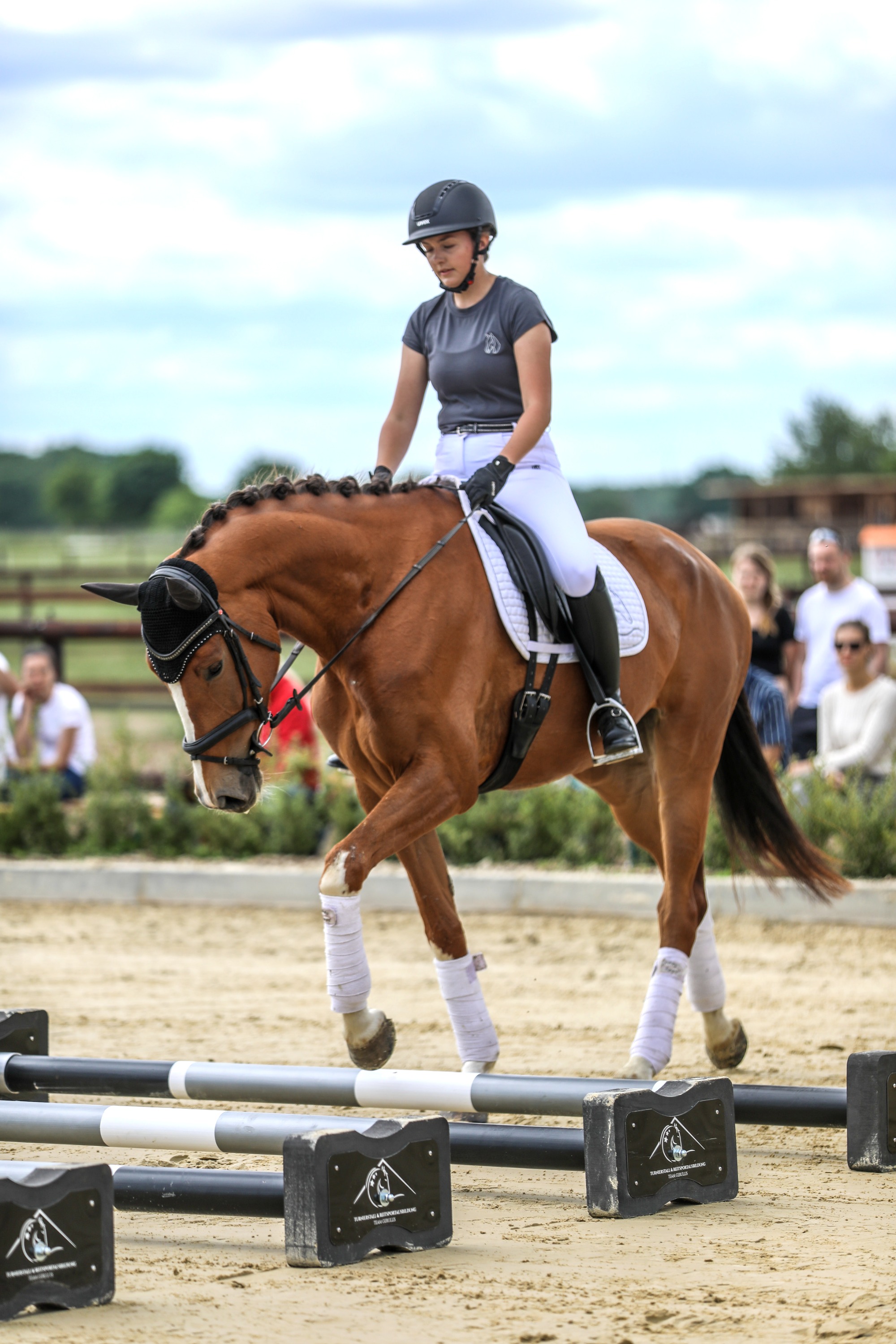
Training content: Contact becomes stable, impulsion comes in, first straightness work. Figures: shoulder-fore, simple flying change in trot, slight tempo variations, simple trot extensions, cantering in figure-8 and 6.
Hours per week: Four to six riding lessons, at least two with a trainer.
Realistic time to level: One to two years from solid Novice level.
Typical pitfalls: Contact doesn’t become honest. Horse comes behind the rein or against the hand. Rider concentrates on figures instead of on the stages contact, impulsion and beginning straightness. Many riders stick here — Elementary is the most critical phase in the entire building.
Phase 3 — Class M (Years 4-6)
Training content: Beginning real collection. Figures: shoulder-in, travers, renvers, simple flying changes, simple pirouettes, flying changes are introduced, extended and collected tempos become clearer.
Hours per week: Five to seven riding lessons, three to four with a trainer.
Realistic time to level: Two to three years from solid Elementary level.
Typical pitfalls: Collection confused with ‘holding together’. Flying changes trained without sufficient preparation. Rider and horse lose suppleness under increasing collection pressure.
Phase 4 — Class S (Years 6-8)
Training content: Real collection is consolidated. Figures: flying changes in series, pirouettes in canter and trot, piaffe and passage are introduced, all figures are ridden in highest collection.
Hours per week: Six to eight riding lessons, at least four with a trainer, regular clinics.
Realistic time to level: Two to three years from solid Medium level.
Typical pitfalls: Riders without enough own riding experience fail at Advanced — seat and aid-giving must be extremely fine. Horses that were collected too early in building work show tensions that inevitably lead to problems at Advanced.
Realistic training costs
The honest cost side, monthly, for a horse in boarding on a good sport riding facility in 2026:
| Cost item | Monthly (euros) | Note |
|---|---|---|
| Boarding (outdoor stall) | 700-900 | At Eichhof Akademie from 900 €, including full facility access |
| Riding lessons (8-12 lessons) | 350-500 | With external trainer or on the facility |
| Farrier | 60-100 | Every 6-8 weeks |
| Deworming and vet (flat rate) | 50-80 | Annual average |
| Competition starts and equipment | 100-300 | Season-dependent |
| Clinics (2-4 yearly) | 150-250 | Annual average |
| Insurance horse and rider | 30-60 | Liability and possibly health insurance |
| Total monthly budget | 1,440-2,190 | Ambitious amateur dressage sport |
Over five years of training that is 86,000 to 131,000 euros in total training costs — in addition to the horse itself. Anyone who doesn’t have this clearly in mind walks the path with false expectations.
How we support at Eichhof Akademie
We offer all building blocks for the path to Advanced under one roof:
- Boarding — outdoor stalls and open stable, with all training surfaces for Advanced-level preparation (20 × 60 m ebb-and-flow dressage arena, indoor arena, second dressage arena)
- Riding lessons — Head Dressage Trainer Kim Jesse (dressage training through Grand Prix, Westphalian Dressage Champion) plus Master Equine Manager Pia Anina Gerullis on clinics and selected training days
- Professional schooling — full training board, part training board, corrective work for horses that need a developmental push
- Clinics with top-tier guest trainers — Karin Lührs (Grand Prix), Christoph Hess (classical methodology), Conny Faste (seat analysis)
This combination is rare in the Berlin area. More on choosing the right riding facility in our post Riding facilities in the south of Berlin.
What you will lose along the way — and gain
Three truths about the roadmap:
First truth: You will have phases of doubt. Plateaus where nothing seems to move for months. Horse problems unrelated to riding (illnesses, injuries). Rider problems related to life phases. Anyone who doesn’t know this gives up too early.
Second truth: The path is not worth it for everyone. Some riders are happy at Novice and should stay there. Others want to ride Medium absolutely without bringing the prerequisites. Honest self-assessment — and an honest trainer — are more important than any ambition.
Third truth: Anyone seriously wanting it and bringing the prerequisites can do it. Not everyone to Grand Prix, but Advanced is achievable with enough talent, time, money and patience.
If you are considering walking this path seriously, arrange an initial conversation. We take time to discuss together your current situation, your goals and realistic next steps.
Roadmap A to S at a glance
| Class | Training focus | Realistic time | Critical pitfalls |
|---|---|---|---|
| A | Rhythm, suppleness, simple contact | 1-2 years | Seat mistakes uncorrected |
| L | Contact stable, impulsion, beginning straightness | 1-2 years | Stuck at L — most critical phase |
| M | Real collection, simple flying changes | 2-3 years | Collection confused with holding |
| S | Flying changes in series, pirouettes, piaffe-passage | 2-3 years | Seat insufficient for high figures |
| Total A → S | Complete classical dressage training | 6-10 years | Impatience |
Further reading
- FN — Training scale (official page, in German) — methodical framework of any classical dressage training
- FN-Verlag — Guidelines Volume 2: Further training for horse and rider (in German) — the official FN source for Elementary-to-Advanced content
- FN — Trainer education (Trainer C / B / A, in German) — qualification levels for riding teachers and professional schooling trainers
- FN — In-depth article on collection (in German) — key topic for the transition from L to M and M to S
- DOKR — German Olympic Committee for Equestrian Sport (in German) — top-sport structures for riders with Advanced and Grand-Prix ambitions
Written by Franziska Gutsche, owner of Eichhof Akademie. We accompany our boarders on this path from A to S — with classical methodology, a permanent trainer team and regular clinics with nationally recognised guest trainers.
Questions & Answers