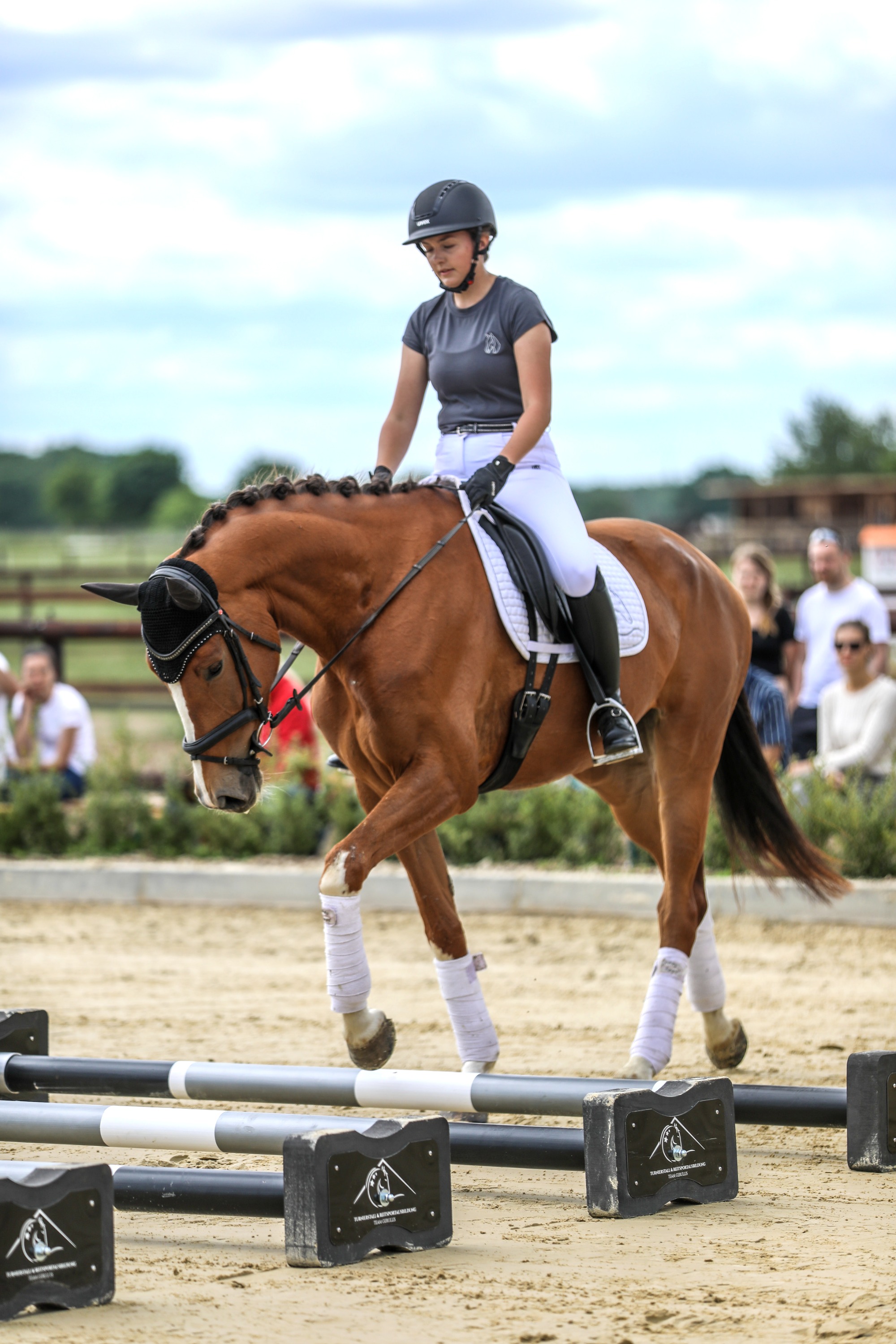
Corrective professional schooling for dressage horses: when is professional help worth it?

At a glance
- Corrective professional schooling is the professional correction of ingrained riding problems in adult horses — typical occasions are resistance, one-sided loading, contact problems, flying-change difficulties or lost trust in the rider's hand.
- Corrective work typically takes three to six months, costs 1,500 to 2,200 euros per month including boarding, and leads to lasting success only when the owner works in parallel on their own riding.
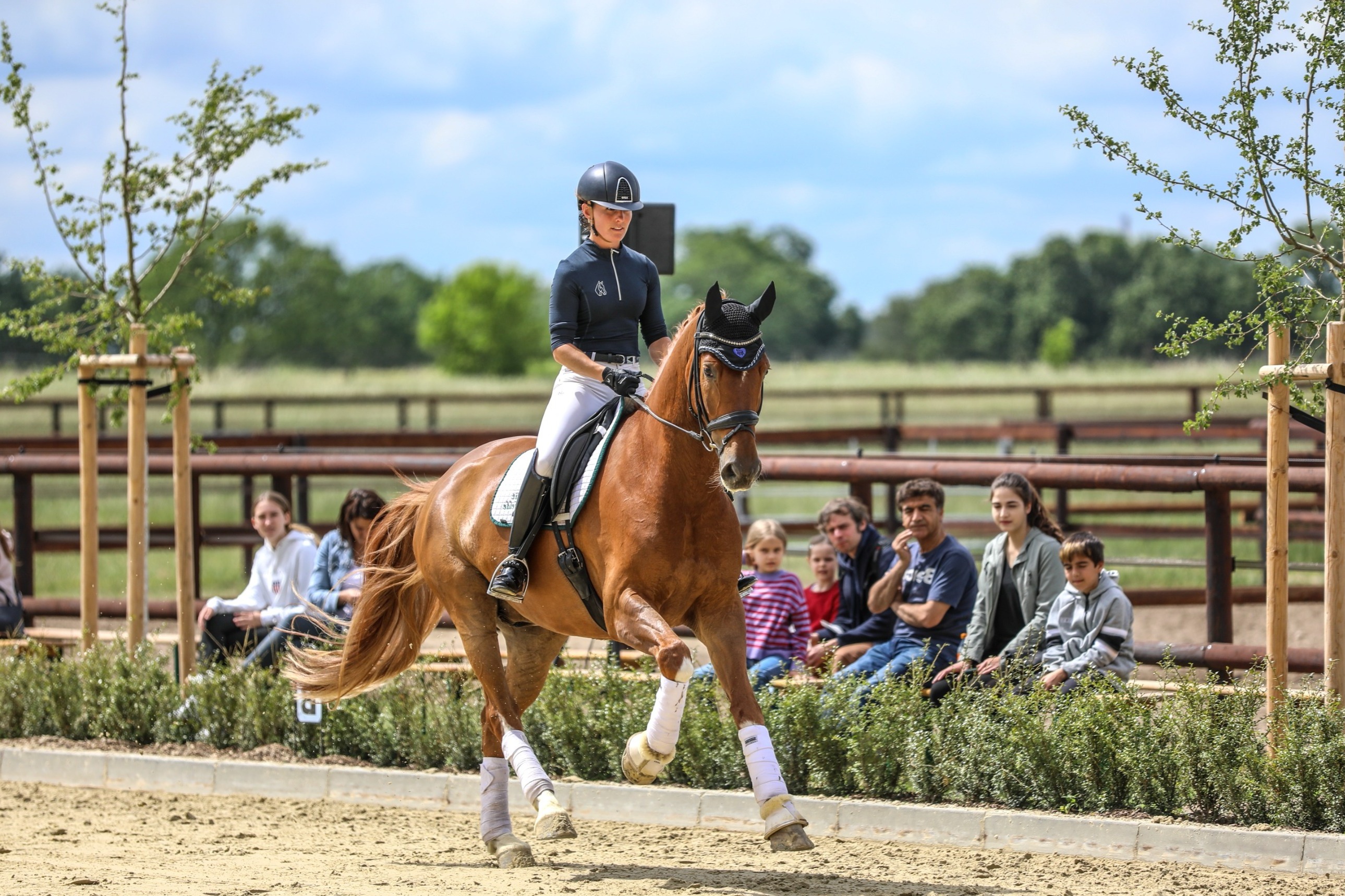
- At Eichhof Akademie our Head Dressage Trainer Kim Jesse (dressage training through Grand Prix, Westphalian Dressage Champion) leads the corrective work — gestützt auf Master Equine Manager Pia Anina Gerullis (Classical Riding Training) and consistently to the FN training scale.
Corrective professional schooling is one of the most honest and at the same time most difficult topics in professional horse training. Honest, because good corrective work openly addresses what has gone wrong — and which gaps exist in the rider training of the owner or in the building work of the horse. Difficult, because ingrained riding patterns cannot simply be trained away — they must be released and replaced with new, correct patterns, which presupposes time, patience and an experienced trainer.
In this article we explain when corrective work really helps, how it practically proceeds, what it costs, and which realistic expectations you should have. We write from the practice of a sport riding facility with its own trainer team that regularly accompanies corrective work.
When corrective work really helps
Corrective work is not the right answer to every problem. Especially not when physical causes are not ruled out. The most important occasions for sensible corrective work:
Contact problems. The horse comes behind the rein or braces against the hand. The contact is not honest but forced or evasive. A corrective phase with a calm, experienced rider can do much here.
Flying-change difficulties. The horse does not change cleanly, only springs through one-sidedly, has no real canter quality. Often a consequence of introducing flying changes too early without sufficient preparation in collection.
One-sided loading. The horse is noticeably stiffer on one side, bends only one-sidedly, occasionally goes lame. If veterinary findings are unremarkable, this is often a training problem — the rider sits crooked, the horse compensates.
Resistance. Rearing, bucking, refusing. Often an expression of pain, fear or overload. First clarify veterinarily, then corrective work — a good trainer finds the cause and works it through.
Missing collection. The horse goes through all classes with sufficient contact but without real collection. The figures ‘work’ but are technical and not from the scale. Here an experienced corrective trainer can begin the building anew.
Loss of trust. The horse goes with fear, is mentally tense, reacts oversensitively to aids. Causes often in early overload or unclear aid-giving over long time.
When corrective work does not help
Equally honestly: corrective work does not solve everything. The following situations need different answers:
Physical causes. Pains from tensions, tendons, joints, teeth, saddle fit. Before every corrective work a thorough veterinary check — otherwise you correct nothing but work against the pain.
Character incompatibility. Some horses don’t fit the rider — due to size, temperament, aptitudes. Corrective work cannot overcome this incompatibility. Sometimes another horse is the right answer.
Rider problems without rider training. If the horse goes correctly as soon as another rider sits on it, it is not a horse problem but a rider problem. Corrective work only shifts the problem — you need lessons for the owner, not professional schooling for the horse.
Over-expectations. Anyone hoping to make an L horse into an M horse in three months of corrective work misunderstands the schooling. Correction solves problems, it does not produce a new class.
How corrective work practically proceeds
At Eichhof Akademie we follow a clear structure:
Phase 1 — Diagnosis (week 1). Head Dressage Trainer Kim Jesse first rides the horse two to three times to capture the current state. What works, what doesn’t, where do the tensions and gaps lie. On the basis of this diagnosis, we discuss with the owner what can be achieved in professional schooling and which expectations are realistic.
Phase 2 — Releasing (weeks 1-4). Back to the foundations. Looseness, rhythm, calm walk-walk-trot transitions. Sometimes we have to leave out figures the horse should actually already master, and spend weeks rebuilding contact and suppleness. This is the most important phase — and often the longest.
Phase 3 — Building (weeks 4-12). As soon as the foundations are stable, we begin the systematic building to the training scale. Contact, impulsion, beginning straightness. Figures are carefully reintroduced, always with an eye on whether the foundations hold.
Phase 4 — Consolidation (weeks 12-20). The horse now rides cleanly. We repeat the corrected movement patterns many times so they become the new routine. Only now does the owner begin to ride regularly again, initially under guidance.
Phase 5 — Handover (weeks 18-24). Shared riding lessons, owner rides, trainer corrects. This phase is decisive for the sustainability of the corrective work. If it is skipped, the results often disappear within a few weeks.
Costs in detail
Corrective work costs in 2026 for a horse boarded and worked at Eichhof Akademie:
| Item | Costs per month |
|---|---|
| Boarding place (outdoor stall) | from 900 € |
| Full training board (4-6 training sessions per week) | 800-1,200 € |
| Farrier (every 6-8 weeks) | 60-100 € (pro-rated) |
| Vet flat rate (vaccination, deworming) | 30-50 € (pro-rated) |
| Total monthly | 1,800-2,250 € |
For the typical three to six months of corrective work, that corresponds to an investment of 5,400 to 13,500 euros. A significant sum — that justifies itself when it lastingly corrects a horse that without this investment would become unrideable or sick.
More on professional schooling costs in general in our post Professional schooling for young dressage horses costs.
What you as owner must do in parallel
Corrective work is only half as effective if the owner does nothing in parallel. Three recommendations:
First: work on your own seat. While the professional schooling runs, take seat lessons on a school horse — either with us on the facility or with an external trainer. When the seat is corrected, you can also correctly ride the horse corrected in professional schooling. More in our post Dressage lessons Potsdam.
Second: consistent observation of the schooling process. Come by regularly, watch, talk to the trainer. This way you see what changes and learn what to recognise as a rider later.
Third: realistic expectations. Corrective work does not produce a different horse. It solves problems. What remains is your horse, now without these problems. If you hope for a ‘finished’ horse that needs to learn nothing more, you will be disappointed.
When should you turn to us?
If you have the following constellation:
- Concrete, clearly describable horse problem
- Veterinary causes are ruled out
- You are ready to invest three to six months in the schooling
- You are ready to work in parallel on your own riding
- You seek a trainer with classical methodology to the training scale
— then we may be the right choice. Contact us for an initial conversation. We take time to hear your situation and honestly say whether we can help or whether another trainer fits better.
Corrective professional schooling at a glance
| Phase | Content | Duration |
|---|---|---|
| Diagnosis | Capture state, discuss plan | Week 1 |
| Releasing | Rebuild foundations | Weeks 1-4 |
| Building | Training scale systematically | Weeks 4-12 |
| Consolidation | Repeat corrected patterns | Weeks 12-20 |
| Handover | Shared riding lessons | Weeks 18-24 |
| Total duration | 3-6 months | – |
| Total costs | 5,400-13,500 € | – |
Further reading
- FN — Training scale (official page, in German) — the methodical foundation of any classical corrective work
- FN — Trainer education (Trainer C / B / A, in German) — qualification levels for serious professional schooling trainers
- FN-Verlag — Guidelines Volume 2: Further training (in German) — the FN standard source for correct building work
- Bundestierärztekammer — X-ray guideline 2018 (press release, in German) — important for veterinary clarification before any corrective work
- Veterinary University Hannover — Equine clinic (in German) — reference clinic for orthopaedic and neurological clarifications
Written by Franziska Gutsche, owner of Eichhof Akademie. Corrective work at the Eichhof is led by our Head Dressage Trainer Kim Jesse — classical methodology to the FN scale, with a clear building plan and transparent communication to the owner.
Questions & Answers