
Tendon and ligament injuries in horses: housing, movement and rebuilding

At a glance
- A tendon or ligament injury does not automatically end a sporting career — but the disappearance of lameness does not mean the tissue can bear full load again.
- Healing runs in overlapping phases over many months. Appropriate, measured loading supports tissue adaptation; overloading can renew the damage.
- The right housing changes with the healing phase: from vet-prescribed box rest to a small fenced-off paddock and back to open stable and pasture — always agreed with the treating vet.
A tendon or ligament injury is a turning point for any horse owner. Suddenly there are questions without quick answers: How long will it take? Will my horse move the way it did before? And what can I do to help?
The good news first: an injury like this does not automatically end a sporting career. The more important news follows right after: when the lameness has gone, the tissue is still far from able to bear full load. Many setbacks happen precisely in that gap.
At Eichhof Akademie we believe the goal should not be the fastest possible return under saddle, but a lasting sporting future. In this article we explain what happens in injured tissue, which form of housing can make sense in which phase, and what a patient training build-up looks like.
Important note: Eichhof Akademie is not a veterinary facility. We are not vets and do not make diagnoses or individual therapy or rehabilitation plans. Every tendon or ligament injury must be examined and supervised by a vet. Housing, amount of exercise, increases in workload and the return to sport take place exclusively in consultation with the treating vet. All timeframes in this article are guide values, not a treatment recommendation for any individual horse.
What happens in injured tissue
In sport horses, the structures most often affected are the superficial and deep digital flexor tendons, the suspensory ligament with its body and branches, and other ligament structures of the limb. Tendons and ligaments consist mainly of collagen fibres aligned lengthwise. This alignment makes them both tensile and elastic.
After an injury, the tissue heals in three overlapping phases:
- Inflammatory phase. In the first days, the body responds with inflammation, swelling and heat. Damaged tissue is broken down and the repair process is prepared.
- Repair phase. Over weeks, new tissue forms. At first it is disorganised and much less resilient than the original tendon.
- Remodelling. Over many months, the new fibres increasingly align in the direction of pull. This phase is the longest and determines how resilient the tissue will become.
So-called mechanotransduction plays an important role here: cells in the tissue respond to mechanical stimuli. Appropriate, measured loading supports the adaptation and alignment of the new fibres. Overloading, on the other hand, can renew the damage. There is also an honest limitation: the original mechanical properties are not fully restored in every case. That makes it all the more important to manage loading so the tissue can reach the best possible quality.
Acute phase: protection from uncontrolled loading
It starts with a veterinary diagnosis, often with ultrasound and further imaging where needed. The vet determines which structure is affected, how severe the injury is and how its progress will be monitored.
Depending on severity and location, this phase includes:
- box rest as prescribed by the vet
- cooling and pain management
- first controlled steps only after clearance
Uncontrolled sprints, bucking, tight turns and slippery ground are particularly problematic in the early phases. These are exactly the movements a horse shows when it is suddenly turned loose after days in the box. At the same time, prolonged immobilisation has drawbacks too — for the tissue, for the musculature and for the horse’s state of mind. The right balance between protection and movement has to be found individually for each horse.
The right housing for each healing phase
Housing is no side issue during convalescence. It determines how much uncontrolled movement a horse has in everyday life, and it affects how calmly it gets through the long recovery. Which form suits depends on the healing phase, not on a fixed conviction.
| Form of housing | Potential | Prerequisite |
|---|---|---|
| Box rest | Maximum control of movement | For acute or unstable findings, as indicated by the vet |
| Small fenced-off paddock | Fresh air, contact with neighbouring horses, limited self-directed movement | Calm horse, safe fencing and veterinary clearance |
| Open stable | Social contact and regular everyday movement | Advanced healing, stable and calm group |
| Pasture | Natural movement and occupation | Sufficient load-bearing capacity; mind the risk of sudden exertion |
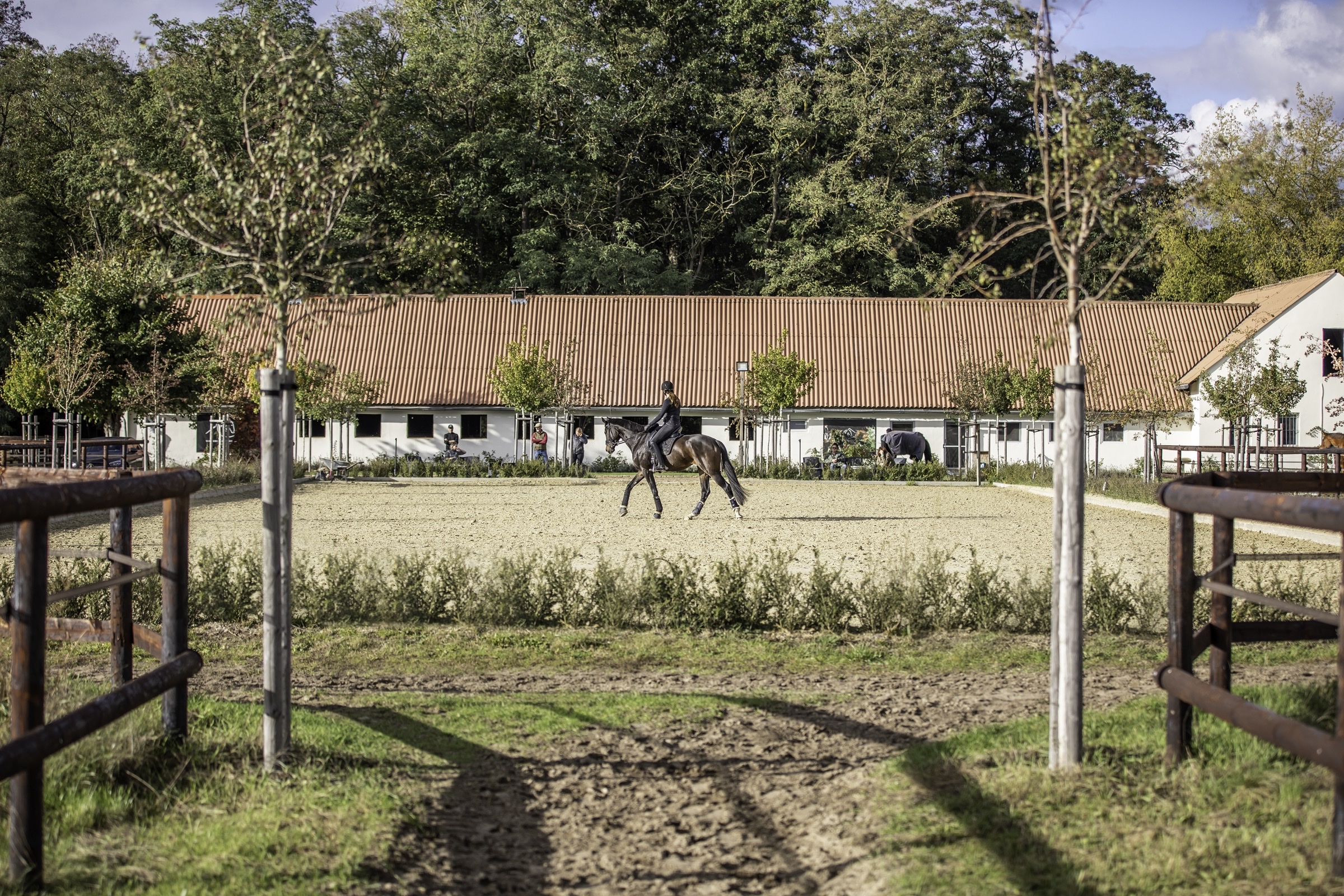
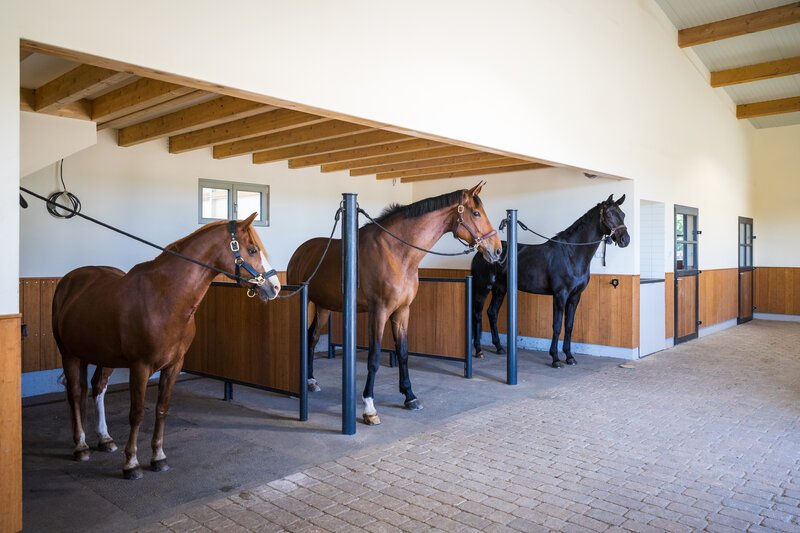
At Eichhof Akademie, depending on the healing phase, we can house horses in boxes, fence off small paddocks so they still stand close to their companions, or later carefully reintegrate them into open stable and pasture housing. The intermediate step of a small paddock within sight of the herd in particular makes the transition easier for many horses: they stay calmer because they are not alone, yet still only move within a limited space.
Scientific context matters too: the benefits of measured, controlled exercise are well described. That is not, however, evidence that free turnout after tendon injuries is superior. Our conviction that a patient, horse-appropriate build-up with gradually more self-directed movement can support long-term soundness is our husbandry concept, not an established study result.
Convalescence: controlled exercise instead of a rigid calendar
Once the vet clears the horse for exercise, the actual rebuilding begins. It does not follow a fixed calendar but the condition of the tissue.
- Walk first, on straight lines. Duration and frequency are increased slowly, often starting with just a few minutes.
- Trot and canter only after check-ups. Trot intervals are added only after clinical and imaging check-ups, canter later still.
- Manage loading by findings. Lameness, heat, swelling, pain, the structure on ultrasound and the tendon cross-section show whether the tissue is coping with the load.
- Plan load and recovery together. Rest days are part of the programme. When new warning signs appear, the session is stopped and the vet is involved before any further loading.
Example of a conservative step-by-step plan
The following overview is explicitly an editorial illustration of a favourable healing course. It is not veterinary clearance and not a binding weekly schedule. Depending on the structure involved and the severity, substantial deviations are necessary.
| Time since injury | Possible focus |
|---|---|
| Weeks 1–2 | Protection, diagnostics and rest; exercise only after clearance |
| Weeks 3–6 | Start of controlled walking, possibly just a few minutes |
| Weeks 7–12 | Walk on straight lines, careful increase in duration |
| Weeks 13–18 | Longer walking sessions; possibly work under saddle |
| Weeks 19–24 | With suitable findings, first short trot intervals |
| Weeks 25–30 | Increase trot; possibly first short canter intervals |
| Weeks 31–42 | Gradual build-up of fitness and canter |
| From approx. week 42 | With clearance, gradual discipline-specific work |
In practice we mainly encounter three approaches, which the vet weighs up depending on the injury:
- Model A: conservative rehabilitation with a long protective phase. Plenty of rest at the beginning, followed by a slow, controlled build-up.
- Model B: early, strictly controlled exercise. For suitable injuries, measured walking starts early, but closely supervised and carefully documented.
- Model C: controlled training with gradually extended self-directed movement. Training is accompanied by housing that allows progressively more free movement, for example from paddock to group. This is an individual concept and not a proven superior standard protocol.
Two gallop tracks: long lines, wide curves
For rebuilding, it matters not only how long a horse works but also where. Eichhof Akademie has two generous gallop tracks with long straights and wide curve radii.
- Long straight stretches make even walk, trot and later canter work easier, without the horse constantly having to make tight turns.
- Wide radii can reduce asymmetric and lateral loading compared with tight turns, but cannot rule it out.
- Speed, footing quality, hoof balance and injury location still remain decisive. A long straight does not replace careful dosing.
Demanding dressage work with small voltes, lateral movements and collection belongs to a much later phase of the build-up.
What does long-term soundness mean?
When people talk about “success” after a tendon injury, it is worth looking closely. There are three separate goals:
- returning to ridden work at all,
- returning to the previous level of performance,
- long-term use without re-injury.
Studies in different horse populations, such as racehorses, show jumpers or dressage horses, report very different return and re-injury rates. These figures cannot simply be compared, because injuries, treatment and demands differ.
An example from dressage: an analysis of 70 dressage horses with suspensory ligament branch injuries published in 2025 (Boado, Pollard and Dyson) found that 44 horses, just under 63 per cent, returned to the same or a higher level of work. 13 horses went on at a lower level and 13 were retired. The authors consider it likely that early recognition with appropriate treatment and management improves the outlook. No conclusion about which form of housing is better can be drawn from this study.
Later sporting fitness also depends on far more than the tendon itself: musculature, fitness, coordination, hoof balance, recovery and sensible training dosage.
Returning to dressage
When the vet gives the green light for discipline-specific work, a phase of its own begins. Here too: foundation before movements.
- First build basic fitness, straight-line work and muscular stability. Plenty of walk, calm trot on large lines, hacking on suitable ground.
- Then coordination and transitions. Only then do lateral movements and collecting exercises gradually return, fully in the spirit of the training scale.
- Increase duration before intensity. And never change several training parameters at once — not longer, faster and more collected in the same step.
- Plan check-ups and documentation. Regular veterinary check-ups and a clear training log help to notice changes early.
Eichhof Akademie: individual paths back to movement
Our strength lies in combining different forms of housing with extensive training facilities:
- medically required box rest in bright, airy boxes with hay around the clock,
- individually fenced-off paddocks with social contact to neighbouring horses,
- suitable open stable and pasture options on more than 25 hectares,
- two long gallop tracks for straight-line rebuilding,
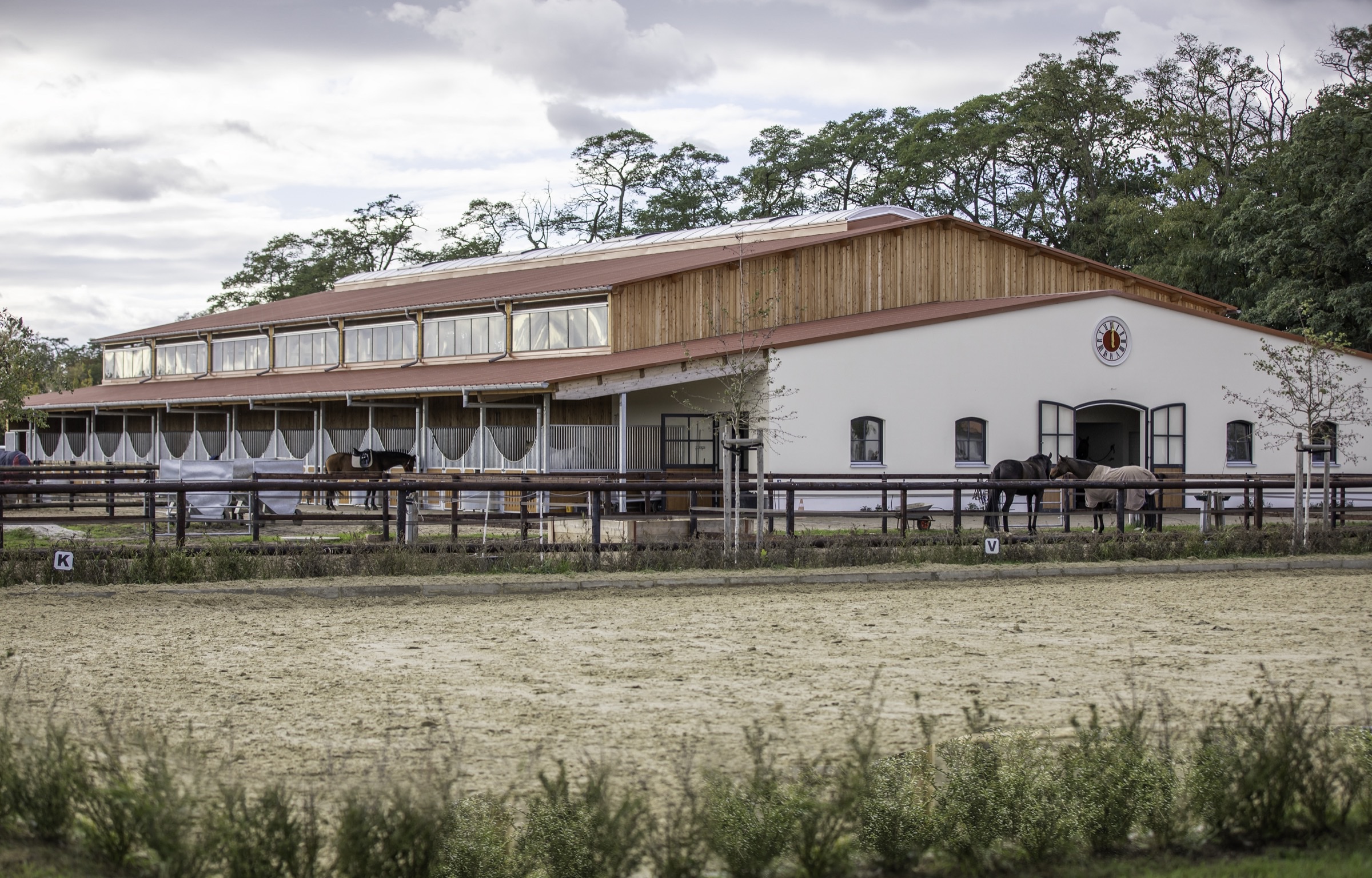
- indoor arena and dressage arena with ebb-and-flow footing for the later return to dressage work.
We always agree the practical implementation with the treating vets. If your horse needs a place for convalescence after a tendon or ligament injury, please get in touch. You can find more about our boarding here, or contact us directly for a personal conversation.
Conclusion
We believe the quality of convalescence should not be measured by how quickly a horse is back under saddle. What matters is how carefully we prepare it for the demands of its later life. That is why we see housing, movement, recovery and training as one — with the aim of supporting quality of life and the longest possible sporting future.
Sources for further reading
- Ellis KL, Giancola S (2025): Guidelines for Formulating Rehabilitation Strategies for Equine Tendon and Ligament Injuries. Veterinary Clinics of North America: Equine Practice. PubMed
- Boado A, Pollard D, Dyson S (2025): Retrospective Analysis of Suspensory Ligament Branch Injuries in 70 Dressage Horses. Animals. PMC
- Equine Rehabilitation: A Scoping Review of the Literature (2021). PMC
- Salz et al. (2023): Treatment of racehorse superficial digital flexor tendonitis. PubMed
- Medical Management of Superficial Digital Flexor Tendonitis (2004). PubMed
Further reading
- Stall, paddock box, open stable, active stable: what suits which horse? — the forms of housing compared
- Open stable or box for competition horses — what you should really compare
- Choosing a boarding yard: the 12-point checklist — what matters when choosing a yard
Questions & Answers