Stall, paddock box, open stable, active stable: which suits which horse?
At a glance
- The four dominant forms of housing in German sport-horse care — stall, paddock box, open stable and active stable — differ not primarily in stall size but in movement budget, social contact and training discipline.
- Scientific findings (including the Göttingen study on German horse husbandry) clearly support group housing with freedom of movement as healthwise superior — for most horses, a mixed form of stall with daily turnout or open stable is optimal.
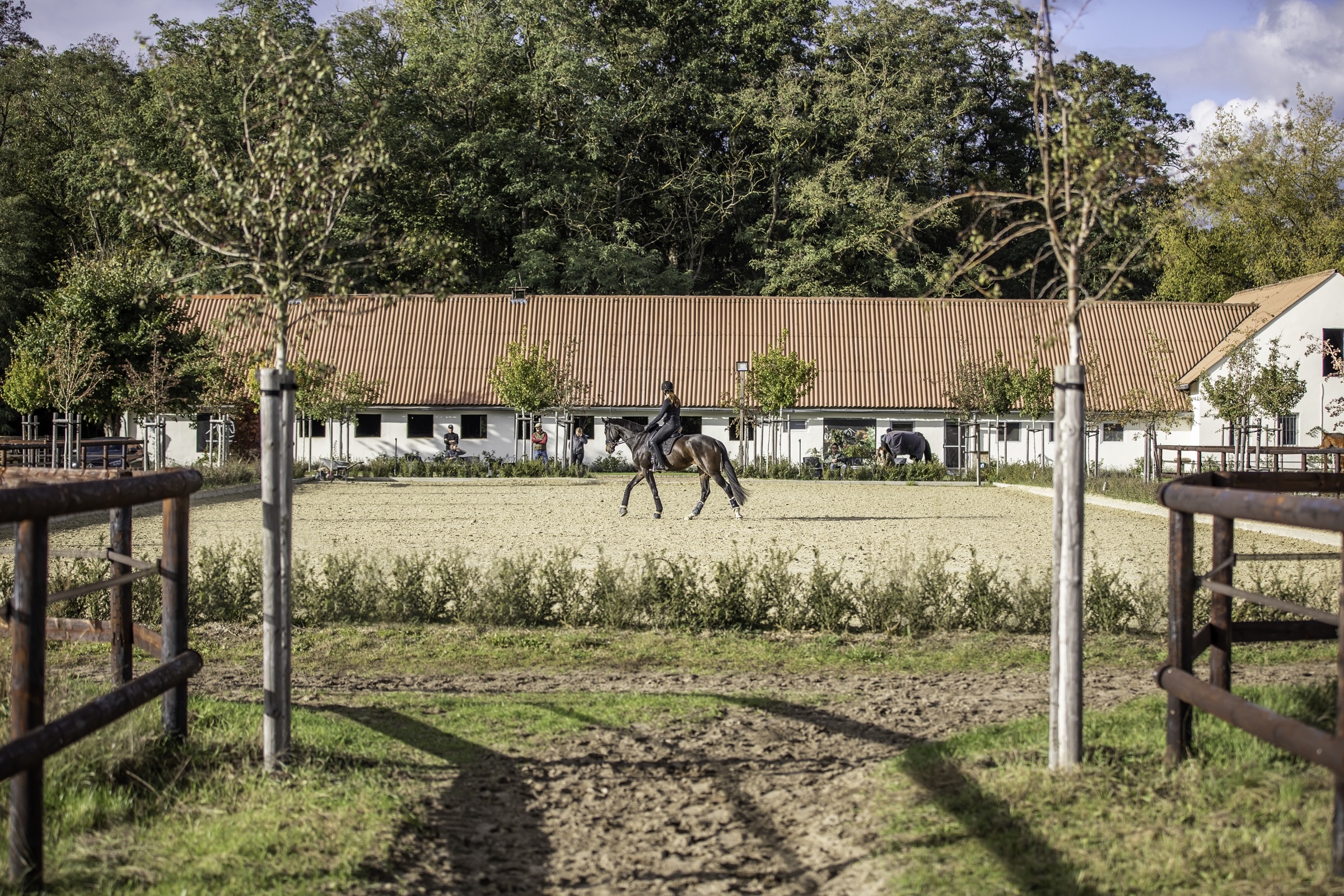
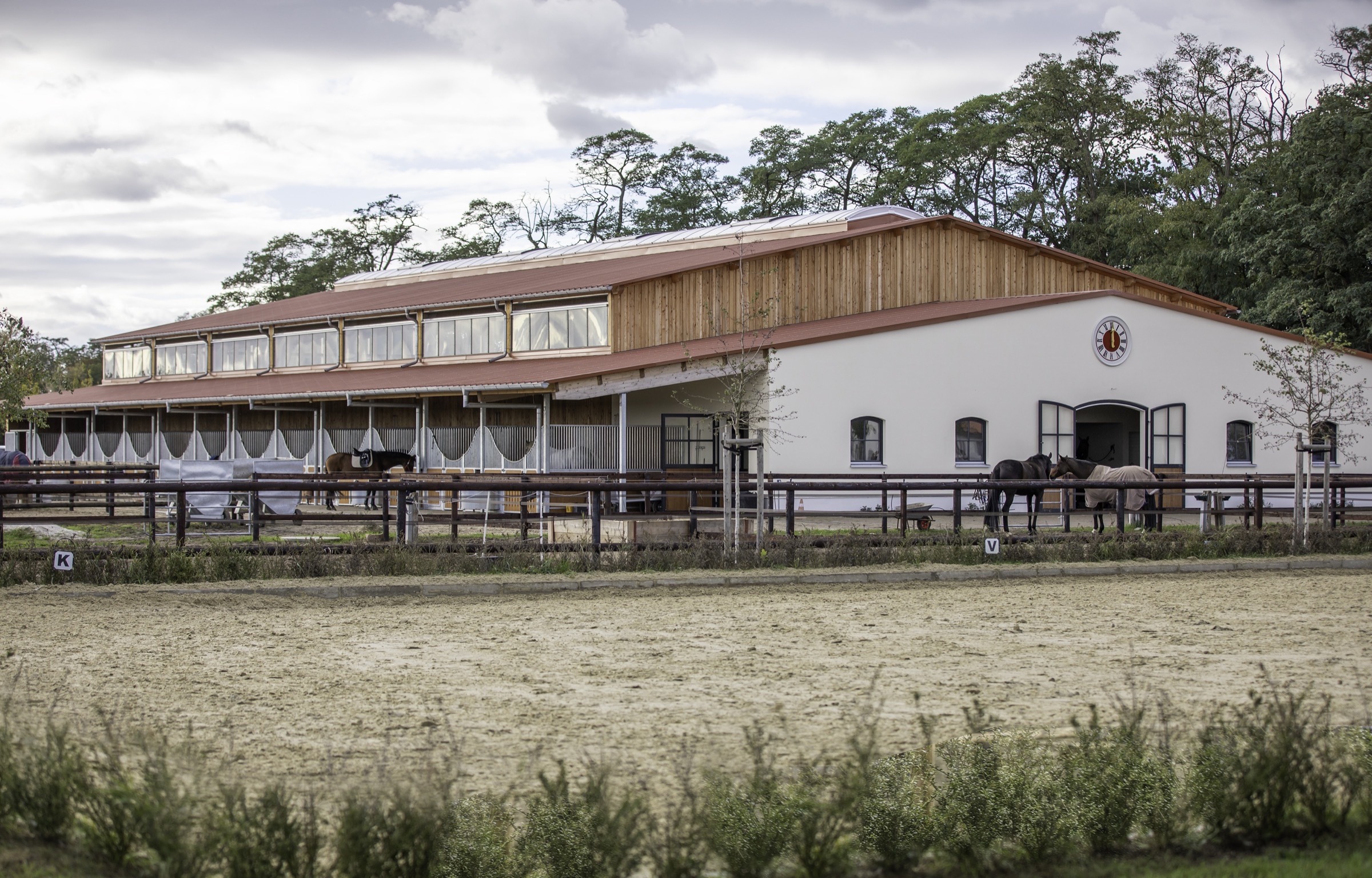
- Eichhof Akademie offers two forms of housing: 35 bright outdoor stalls with daily paddock turnout and four to five open stables in homogeneous groups. Both are modern, airway-friendly solutions for sport horses.
The choice of the right form of housing is one of the most important decisions a horse owner can make for their horse. It affects airway health, musculoskeletal system, digestion, mental condition, and thus rideability over the next ten to twenty years. Yet many riders decide this question on the basis of tradition (“my last horse was also in the stall”) or price (“open stable is cheaper”) — neither a good criterion.
In this article we objectively compare the four dominant forms of housing — pure stall, paddock box, open stable and active stable. We show what scientific evidence exists, which form is suitable for which horse, and what we concretely offer at Eichhof Akademie.
The four forms of housing at a glance
Before we compare, let us define the terms.
Pure stall. Closed horse accommodation without direct outside access. The horse only comes out for movement when the staff bring it out. Common on older facilities, in sport riding stables with high occupancy density, and for horses with limited mobility.
Paddock box. The stall is connected with a directly attached turnout area that the horse can enter and leave independently at any time of day. Today the most common form on modern sport facilities.
Open stable. Several horses live together in a facility with lying area, hay supply and turnout — without individual stalls, with social contact around the clock. Groups can be composed by sex, age or social compatibility.
Active stable. Special form of group housing on the HIT system or comparable concepts. Hay supply, drinkers, concentrate stations and lying areas are distributed across the site — the horses wander daily between them. Movement is built into the concept.
What the scientific evidence says
Three central insights shape today’s horse-husbandry research:
Freedom of movement is a central health factor. Horses are running animals — observations of wild horses show daily distances of roughly 8 to well over 20 kilometres, depending on habitat. Lack of movement leads to tension, digestive problems (colic risk), mental stress and, long-term, lamenesses. Horses in freedom of movement have measurably better movement patterns and fewer orthopaedic problems.
Social contact is not optional. Horses are herd animals. Isolation in the individual stall leads to stress, behavioural abnormalities (weaving, cribbing, aggression) and a weakened immune defence. Even sight contact to the neighbouring horse is often not enough — physical contact with mutual grooming and calming is the natural form of equine relationship.
Airway health depends on the barn climate. Equine asthma is one of the most under-diagnosed conditions in sport horses. Straw, closed barn aisles and poor ventilation are the main risk factors. Bright outdoor stalls with shavings and group housing with fresh air are the most effective preventive measures.
The structural data collection of the University of Göttingen (“Pferdehaltung Heute”) provides the most important market overview of forms of housing in Germany; the scientific evidence on movement, social contact and airway health is additionally supported by the ACVIM Consensus on Equine Asthma, FN guidelines and BMEL animal welfare guidelines 2020. The consequence is clear: group housing with freedom of movement is the healthwise superior form, followed by paddock box with large turnout. Pure stall housing without sufficient daily turnout is animal-welfare-problematic.
Pros and cons of the four forms in detail
Pure stall.
- Advantages: maximum control (feeding, observation, safety). Suitable for convalescent horses, very old horses with limited movement, acutely sick horses requiring rest.
- Disadvantages: lack of movement, poor airway health, socialisation deficit, higher risk of behavioural abnormalities.
- Suitable for: emergencies, transition phases, very specific medical situations.
Paddock box.
- Advantages: combines safety of the stall with freedom of movement. Individual feeding possible. Social contact to the neighbouring horse. Airway health better than with pure stall.
- Disadvantages: social contact limited (no direct body contact). Movement amount depends on paddock size. Higher costs than pure stall.
- Suitable for: most sport horses, sensitive horses, horses with individual feeding needs.
Open stable.
- Advantages: 24/7 freedom of movement. Full social contact. Best airway health. Lower costs. Ideal for young horses.
- Disadvantages: less control. Problems with very high- or low-ranking horses in groups. Individual feeding more difficult. Weather protection important.
- Suitable for: young horses, socially compatible horses, horses with airway problems, horses needing much movement.
Active stable.
- Advantages: maximum movement built into the concept. Full social contact. Structured hay supply. Mineral and concentrate stations with identification.
- Disadvantages: high requirements on herd management and facility size. Problems with very high-ranking horses. High initial investment for operators. Not available everywhere.
- Suitable for: young and healthy sport horses, horses that need much movement, horses that cope well in groups.
Which form for which horse?
Six profiles that frequently occur in practice:
Young horse (3-7 years), healthy, socially compatible. Recommendation: open stable or active stable. The freedom of movement and social contact are particularly important at this age for physical and mental development.
Sport horse in competition training, sensitive, with individual feeding. Recommendation: paddock box or bright outdoor stall with daily paddock turnout. The combination of movement, individual feeding and safety works well.
Sport horse in competition training, robust, socially well-compatible. Recommendation: open stable in a homogeneous group — provided the facility concept allows it. More movement than in the stall, less stress, better airway health.
Horse with equine asthma or allergies. Recommendation: open stable or bright outdoor stall with shavings. Avoid straw and closed barn aisles.
Older horse (18+), limited mobility. Recommendation: paddock box with not-too-large paddock, in quiet neighbourhood. Social contact with neighbours possible, but no pressure of group dynamics.
Horse with acute injury, need for rest. Recommendation: pure stall temporarily, with medically defined movement. As soon as medically possible, back to paddock box or open stable.
What we offer at Eichhof Akademie
We combine two forms of housing:
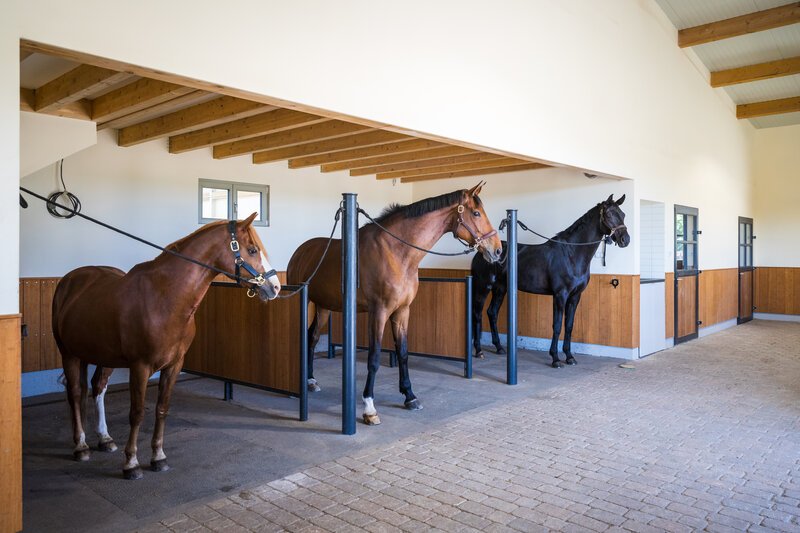
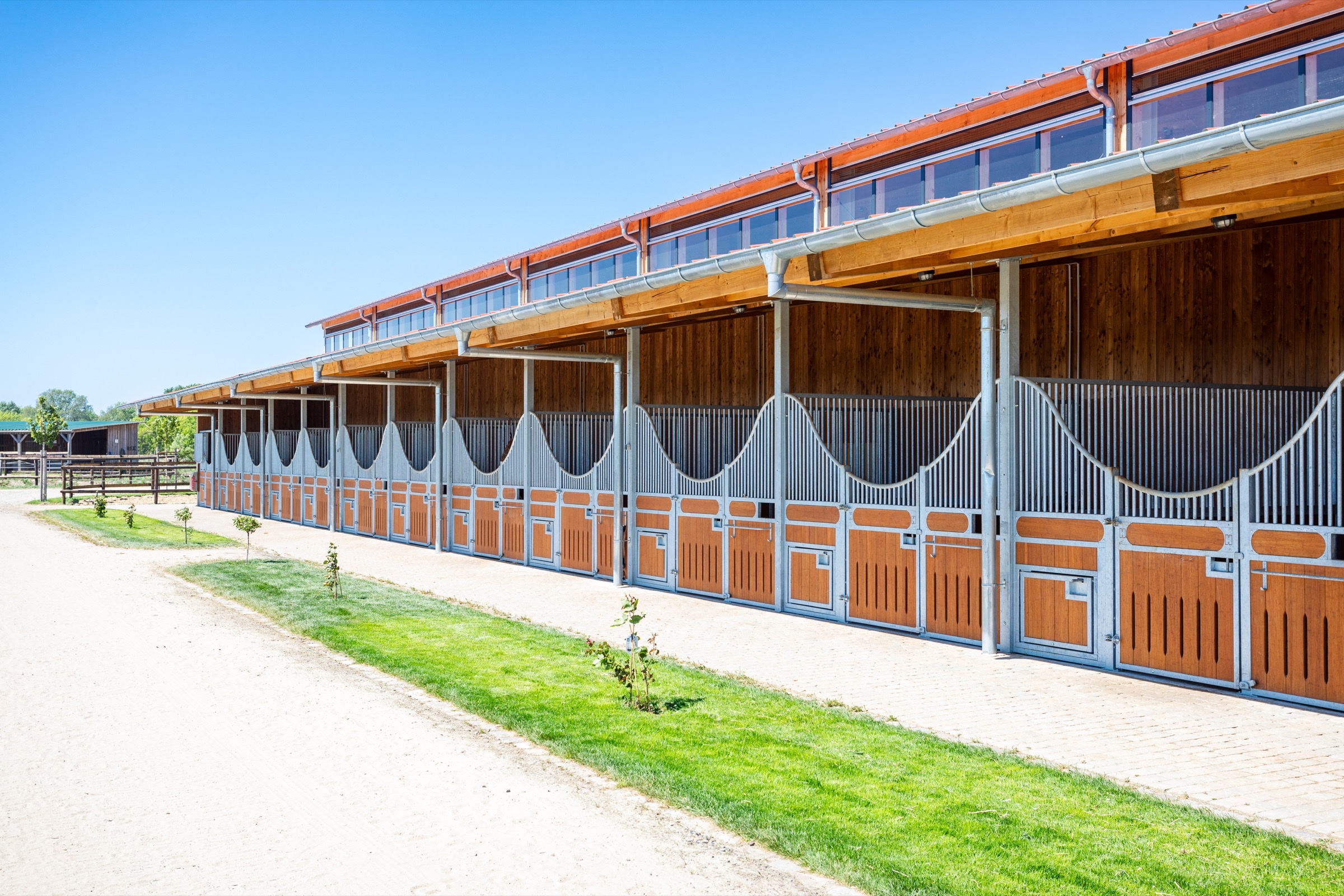
35 bright outdoor stalls in the 4 × 4 m format (existing building 3.75 × 4 m), wood-shavings bedding, daily mucking out, daily paddock turnout from 7:30 to 15:30, evening check around 8 pm. Full facility access. From 900 euros per month.
Four to five open stables in homogeneous groups, separated by geldings and mares. Hay available around the clock, wood-shavings bedding on the lying area, daily droppings collection, half-day summer pasture. From 500 euros per month.
We deliberately dispense with pure indoor stalls without outdoor access. Our outdoor stalls all have direct daylight access and are built so that the airway environment remains good even in summer. We don’t build our facility on the principle of ‘maximum stall count per square metre’ but on the principle of ‘healthy housing for every horse’.
If a horse during boarding with us wishes to switch from stall to open stable or vice versa — for example because needs change — we go through that individually. We know every horse personally and advise boarders on this question.
How to make the right choice
Three questions lead to the right decision:
First: What movement and social needs does my horse have? Young, social horse? Older horse with routine? Sensitive horse with individual needs?
Second: Which facilities in my region offer which form? In Berlin/Brandenburg all four forms are available, but quality varies significantly. More in our market overview of riding facilities in the south of Berlin.
Third: Which costs can and want I to bear? A good paddock box costs 200 to 300 euros more per month than an open stable. For a high-value sport horse this investment is often sensible — for a robust leisure horse, open stable without loss of comfort is possible.
If you are considering which form is right for your horse, arrange a visit with us. We take time to show both options on site and advise on the basis of your concrete situation.
Four forms of housing in direct comparison
| Aspect | Pure stall | Paddock box | Open stable | Active stable |
|---|---|---|---|---|
| Freedom of movement | Low | Medium-high | Very high | Very high |
| Social contact | Low | Medium | High | High |
| Individual feeding | Very good | Very good | Difficult | Good (with stations) |
| Airway environment | Depends on barn | Mostly good | Very good | Very good |
| Control/observation | Maximum | High | Medium | Medium |
| Costs (Berlin south 2026) | 450-700 € | 550-800 € | 400-600 € | 500-650 € |
| Suitable for (examples) | Convalescent | Sensitive sport horse | Young horse, asthma | Robust sport horse |
| Available at Eichhof | – | ✓ (outdoor stall 900 €) | ✓ (500 €) | – |
Further reading
- FN — Individual and group housing (in German) — minimum dimensions and social-contact requirements for all forms of housing
- Guidelines for the assessment of horse husbandry (BMEL 2020, PDF, in German) — federal guideline as minimum standard
- FN — Turnout and pasture (in German) — movement budget for the different forms of housing
- Tierärztliche Vereinigung für Tierschutz — Horse fact sheets (in German) — veterinary recommendations including on hay nets (fact sheet 198 Dec 2025) and barn climate
- Structural data collection of horse-keeping operations (Uni Göttingen) — scientific survey “Pferdehaltung Heute” with data from 850 operations and 16,000 horses
Written by Franziska Gutsche, owner of Eichhof Akademie. Eichhof Akademie combines bright outdoor stalls with shavings (35 places) and four to five open stables in homogeneous groups — deliberately no pure indoor stall housing.
Questions & Answers