Choosing a boarding yard: the 12-point checklist for sport-horse owners

At a glance
- The choice of the boarding yard decides two thirds of the quality of life of your sport horse — and you best make this decision once every five to ten years, not annually.
- Twelve check points separate serious boarding operations from pure property administrators: from movement budget through airway environment and training surfaces to vet reachability at night.
- Always visit at least three facilities, talk to non-introduced boarders, read the boarding contract at home in peace — and don't decide on the first visit.
The choice of the boarding yard is one of the most important decisions you will make for your horse. It decides two thirds of the quality of life of your sport horse — and it affects everything that follows in training, in health, and in the relationship between rider and horse. Yet many riders decide this question surprisingly superficially.
We have advised many buyers, boarders and horse owners in recent years — and we have seen again and again that the most important check points are overlooked on the first visit. This article summarises the twelve points we know from our practice at Eichhof Akademie as decisive. Print out the list, take it to the visit, compare systematically.
Point 1 — Daily movement budget
How many hours is my horse outside the stall daily? The FN calls for “multi-hour daily free movement”, the 2020 BMEL guidelines emphasise lasting movement and social needs. In practice we recommend for a sport horse at least six to eight hours daily outside the stall — paddock turnout, pasture and pure riding training combined.
Have it shown concretely: when do the horses go out? When do they come back in? Which horses are out today, which not — and why?
If the answer is vague or horses “due to bad conditions” stay one or more days in the stall in winter, that is a clear warning sign. A serious yard has a plan for every weather condition.
Point 2 — Airway environment in the barn
When entering the stable aisle, free your nose and breathe deeply. Smells of fresh straw or shavings — okay. Ammonia stings the nose — critical.
Concrete check points:
- Bedding: straw or shavings? Shavings are lower in dust and noticeably better tolerated by horses with asthma tendency than straw.
- Ventilation: are stable windows open or closed? Is there cross-ventilation or a mechanical ventilation system?
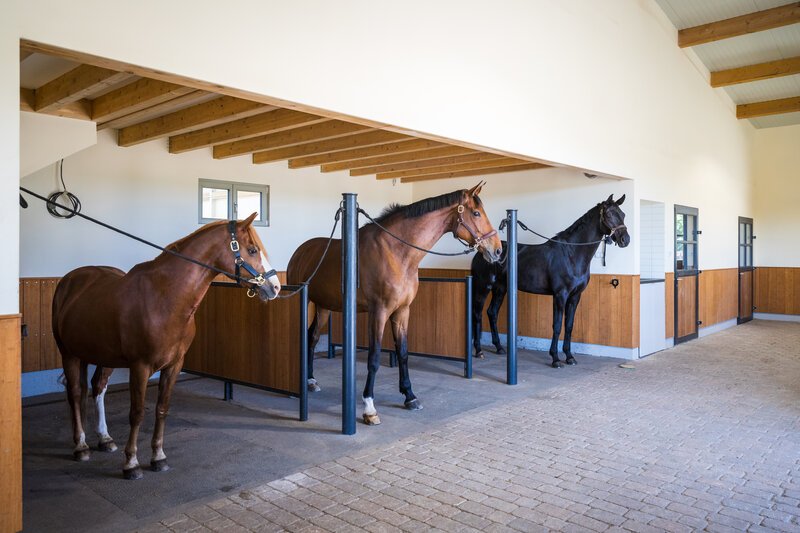
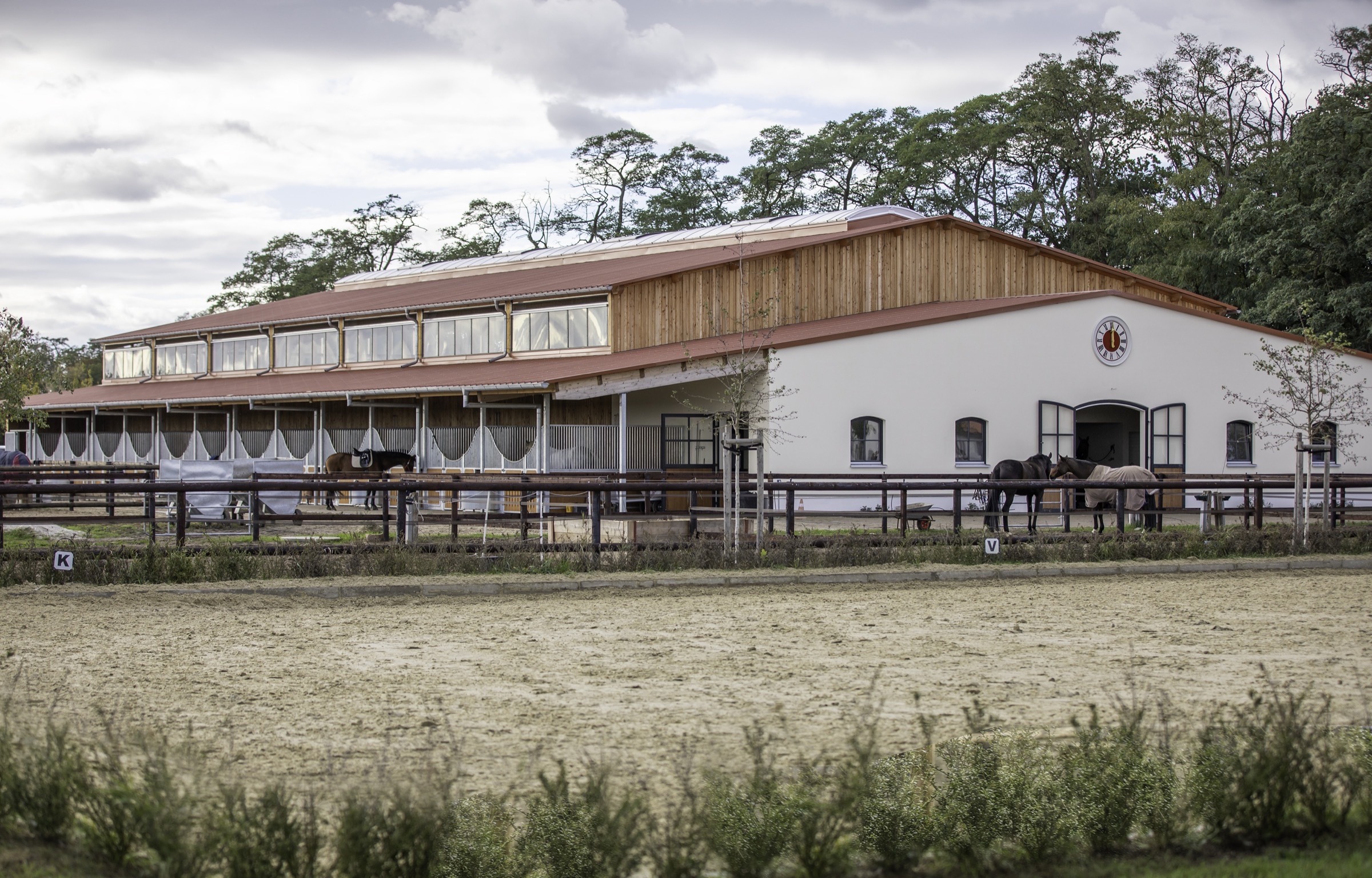
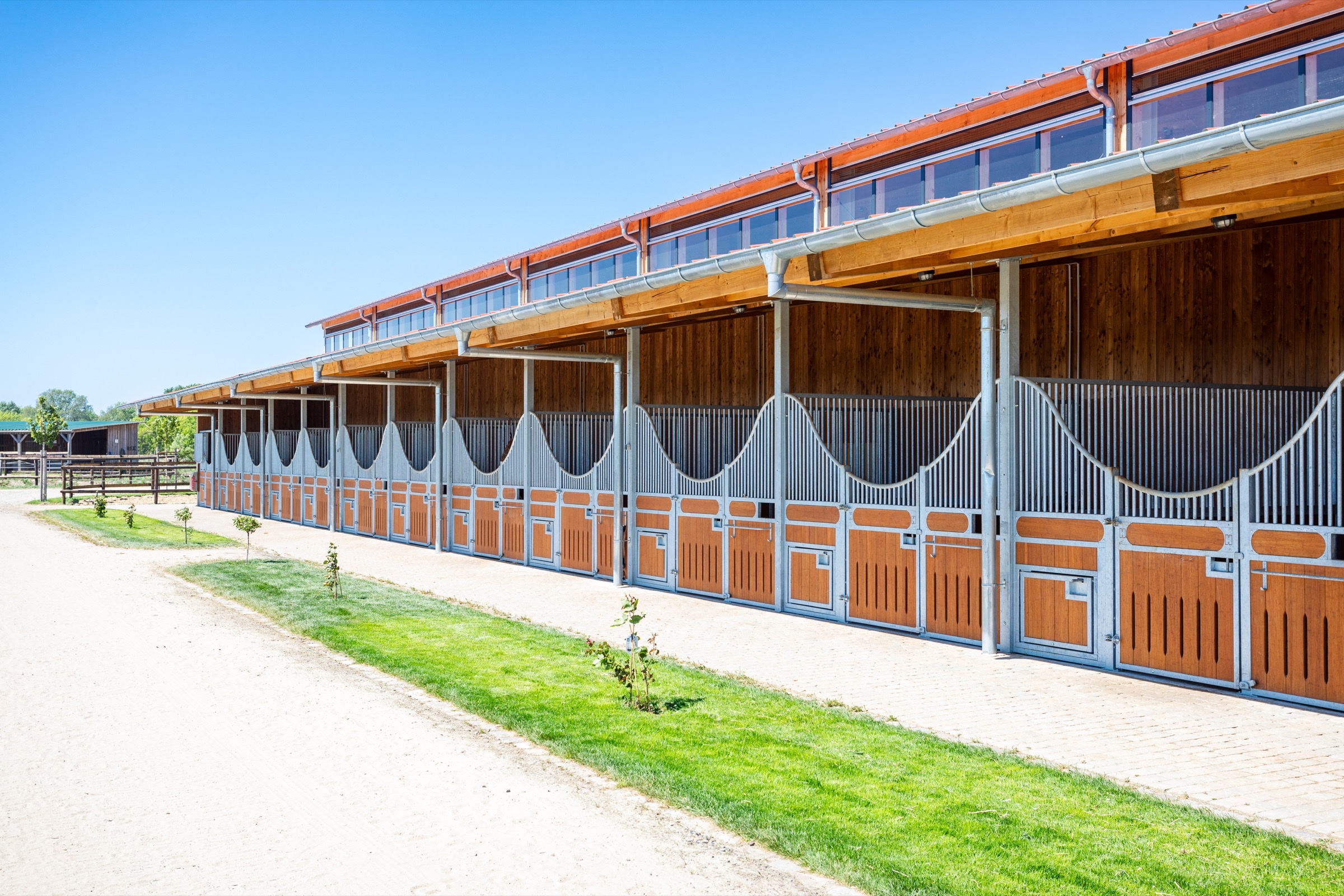
- Stable form: closed indoor stalls or bright outdoor stalls? Outdoor stalls almost always have the better airway environment.
- Mucking interval: how often is mucking done? Once a day is minimum, twice a day better.
More background on airway health and forms of housing in our post Open stable vs. stall for competition horses. For a systematic overview of all three housing forms with a decision guide, see our comparison of stall, open stable and active stable.
Point 3 — Training surfaces
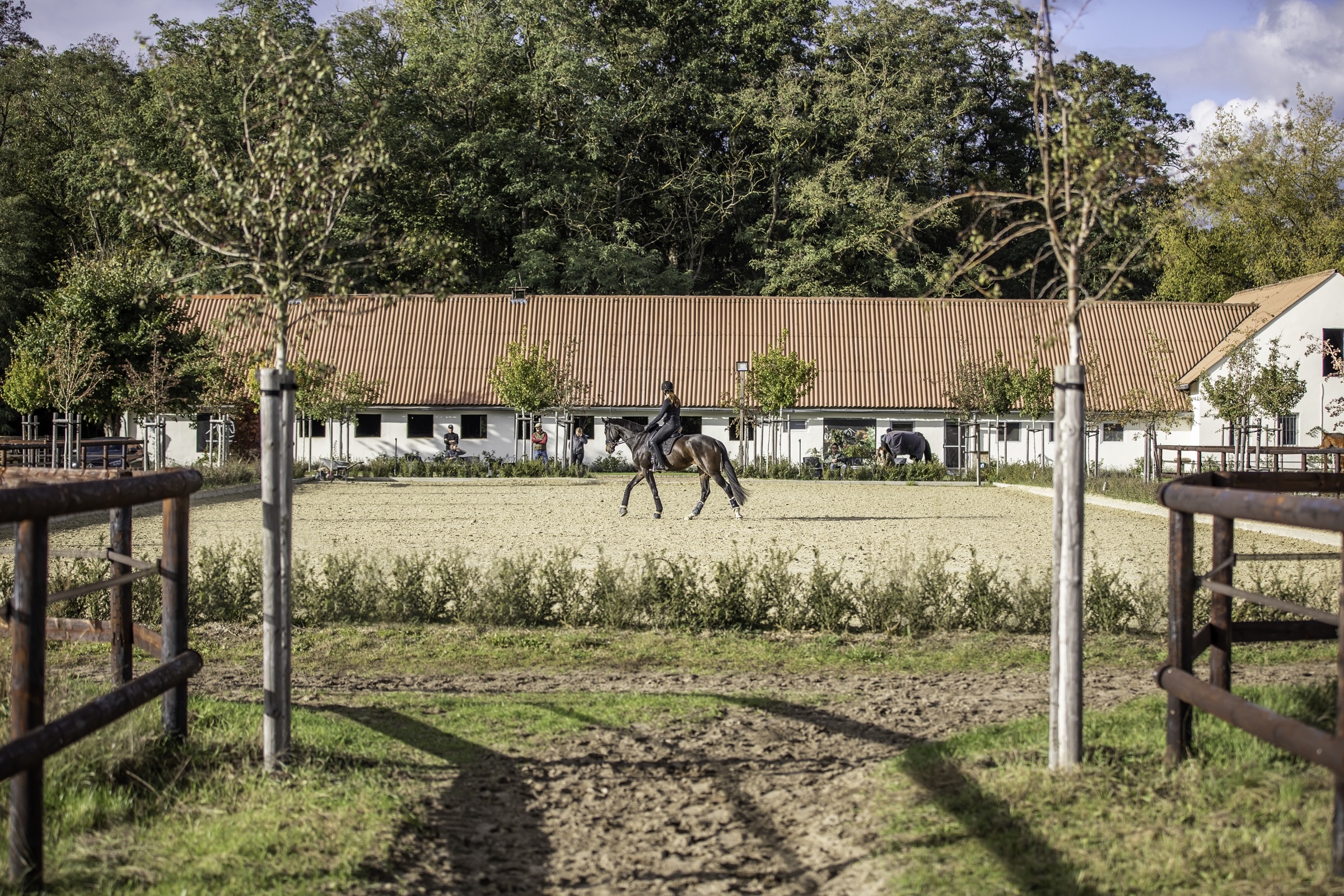
Riders who keep a sport horse in the south of Berlin spend many hours on arenas. The quality of these surfaces decides about tendons, ligaments and long-term movement health.
Check:
- Number and size of arenas: at least one dressage arena at competition size (20 × 60 m), ideally with indoor arena for winter and rain.
- Footing type: ebb-and-flow construction or classical riding sand? Ebb-and-flow keeps the footing elastic year-round.
- Maintenance intervals: how often is harrowing done? Who does it? When are arenas maintained — in the morning before riding or only in the afternoon?
- Occupancy density: how many riders share an arena at peak times? Anyone without a calm training arena cannot train consistently.
Point 4 — Staffing strength and vet reachability
In an emergency — colic suspicion at 11 pm, injury on Sunday — the staff structure decides about life or death of the horse. Clarify concretely:
- Who works daily on the yard? How many people per horse count?
- Who does the final evening check? At what time?
- Who is reachable at night for emergencies?
- Is there a clear emergency chain with vet contacts the staff knows?
In a good boarding facility, a written emergency list with contacts and procedures exists. Anyone who doesn’t have this is not equipped for an emergency.
Point 5 — Feeding management
Who feeds when and what? This question seems banal but is central. Concrete check points:
- Hay supply: how often? What quality? Is the quantity adjusted individually?
- Concentrates: which kinds? Who decides the quantity?
- Special needs: mash, hay cobs, muesli, mineral feed — possible? Surcharge?
- Drinking water: drinkers or buckets? In winter heated or not?
- Pasture access: which pastures, which care, which size per horse?
Anyone with a horse with special requirements — allergies, breeds with special feeding needs, gastric diseases — should clarify this in advance and record it in writing.
Point 6 — Stall equipment
Concretely check:
- Stall size: minimum 3.5 × 3.5 m, better 4 × 4 m
- Ventilation: window, door, ventilation shaft
- Brightness: daylight or only artificial light
- Floor: rubber mats or direct concrete, with sufficient bedding
- Drinker: self-drinker or bucket
- Hay net or hay rack: present, how mounted
- Wall between stalls: solid or grid (social contact vs. conflict)
Point 7 — Facility safety
Are the facilities built and maintained so that daily risk is minimal?
- Fences: intact, safe (wood or rope), no wire
- Gates: close safely, no pinch points
- Stable aisles: non-slip, no trip hazards
- Fire protection: extinguishers, emergency exit, smoke detectors
- Emergency exits in case of panic in the indoor arena
Point 8 — Hygiene and disease management
How does the facility handle diseases?
- Quarantine stall for new arrivals and sick horses
- Vaccination management: who checks boarder vaccination passports? Which mandatory vaccinations?
- Deworming management
- Hygiene between stalls and equipment
A facility with clear hygiene rules is a facility that takes infectious diseases seriously — and thus protects your horses.
Point 9 — Training offer
Which trainers work on the facility? Which qualifications? Which regular clinics?
- Permanent trainer team with FN licences or Master Equine Manager title
- Regular clinics with guest trainers
- Discipline breadth: only dressage or also seat lessons, groundwork, jumping
- Boarder riding-lesson allowance: is there a limit on hours per month?
At Eichhof Akademie regular riding lessons and professional schooling are reserved for boarders; outside riders are welcome at clinics.
Point 10 — Social culture
A facility has its own culture. You notice it already on the first visit.
- Are boarders friendly and relaxed or stressed and annoyed?
- Are there cliques and camps or a mixed group?
- Are new arrivals welcomed?
- What is the tone between staff and boarders?
Anyone who boards in a facility where conflicts dominate has no relaxed riding everyday life in the long run.
Point 11 — Boarding contract in detail
Have the boarding contract sent in advance and read it at home, not in the initial conversation. Check:
- Exact service description
- Prices including VAT, no hidden additional costs
- Price stability: guaranteed for how long? Increase notice period?
- Two-way notice period
- Liability regulation for damages to horse, facility, persons
- Vet cost management: who pays, who decides
- House rules: what is allowed, what not
What is not in the contract cannot be enforced in dispute — regardless of what was promised verbally.
Point 12 — Personal compatibility
In the end what counts: do you and the facility fit together? A sport boarding yard with competition orientation is wrong for a relaxed trail rider — and vice versa. A leisure yard with a relaxed culture doesn’t fit an ambitious amateur with ranking ambitions.
Ask yourself honestly:
- Which discipline do I practice?
- What level am I currently at?
- What goals do I have for the next two to three years?
- Which culture fits my personality?
A good facility tells you honestly whether you fit — even when this speaks against their own sale. Anyone who talks you into it may fit you, often not.
How to proceed practically
Three steps lead to the right decision:
First: Write a requirements list with your most important criteria (movement budget, training offer, commuting time, price range).
Second: Visit three to four facilities, 60 to 90 minutes each, with this checklist in hand.
Third: Compare systematically, read the contract at home in peace, talk to non-introduced boarders, decide after three to seven days of consideration.
If you are considering whether Eichhof Akademie fits your horse, arrange a viewing. We are happy to take 60 to 90 minutes for an honest tour, answer all questions on site, and send you the contract in advance.
Summary — the 12-point checklist
| # | Check point | Minimum requirement |
|---|---|---|
| 1 | Movement budget | 6-8 hours daily outside stall (FN: multi-hour free movement) |
| 2 | Airway environment | Shavings, outdoor stall or good ventilation |
| 3 | Training surfaces | Dressage arena 20 × 60 m, ideally indoor |
| 4 | Staffing strength | Evening check, night-time reachability |
| 5 | Feeding | Individually adjustable, good hay quality |
| 6 | Stall equipment | At least 3.5 × 3.5 m, bright, ventilated |
| 7 | Facility safety | Intact fences, safe doors, fire protection |
| 8 | Hygiene management | Quarantine stall, vaccination control |
| 9 | Training offer | Permanent team, regular clinics |
| 10 | Social culture | Relaxed, integrative, clear communication |
| 11 | Boarding contract | Written, all services detailed |
| 12 | Personal fit | Discipline, level, goals aligned |
Further reading
- Guidelines for the assessment of horse husbandry under animal welfare aspects (BMEL 2020, PDF, in German) — federal guideline for animal-welfare-compliant horse husbandry
- FN — Horse husbandry overview (in German) — standards of the German equestrian federation
- Tierärztliche Vereinigung für Tierschutz — Horse fact sheets (in German) — specialist standards on barn climate, rider weight, hay nets
- FN-Shop — Horse boarding contract (model contract, in German) — the official FN model contract for boarding contracts
- Veterinary University Hannover — Equine clinic (Internal Medicine, in German) — standards for airway diagnostics and equine asthma
Written by Franziska Gutsche, owner of Eichhof Akademie. This checklist comes from the daily practice of a sport riding facility that itself applies high quality standards to boarding and training.
Questions & Answers