Open stable or stall for sport horses: what to actually compare

At a glance
- Open stables and outdoor stalls can both keep a sport horse healthy — what matters is the quality of management, not the housing form itself.
- Equine asthma is one of the most under-diagnosed conditions in sport horses; open stalls, wood-shavings bedding and long turnout times are clear protective factors.
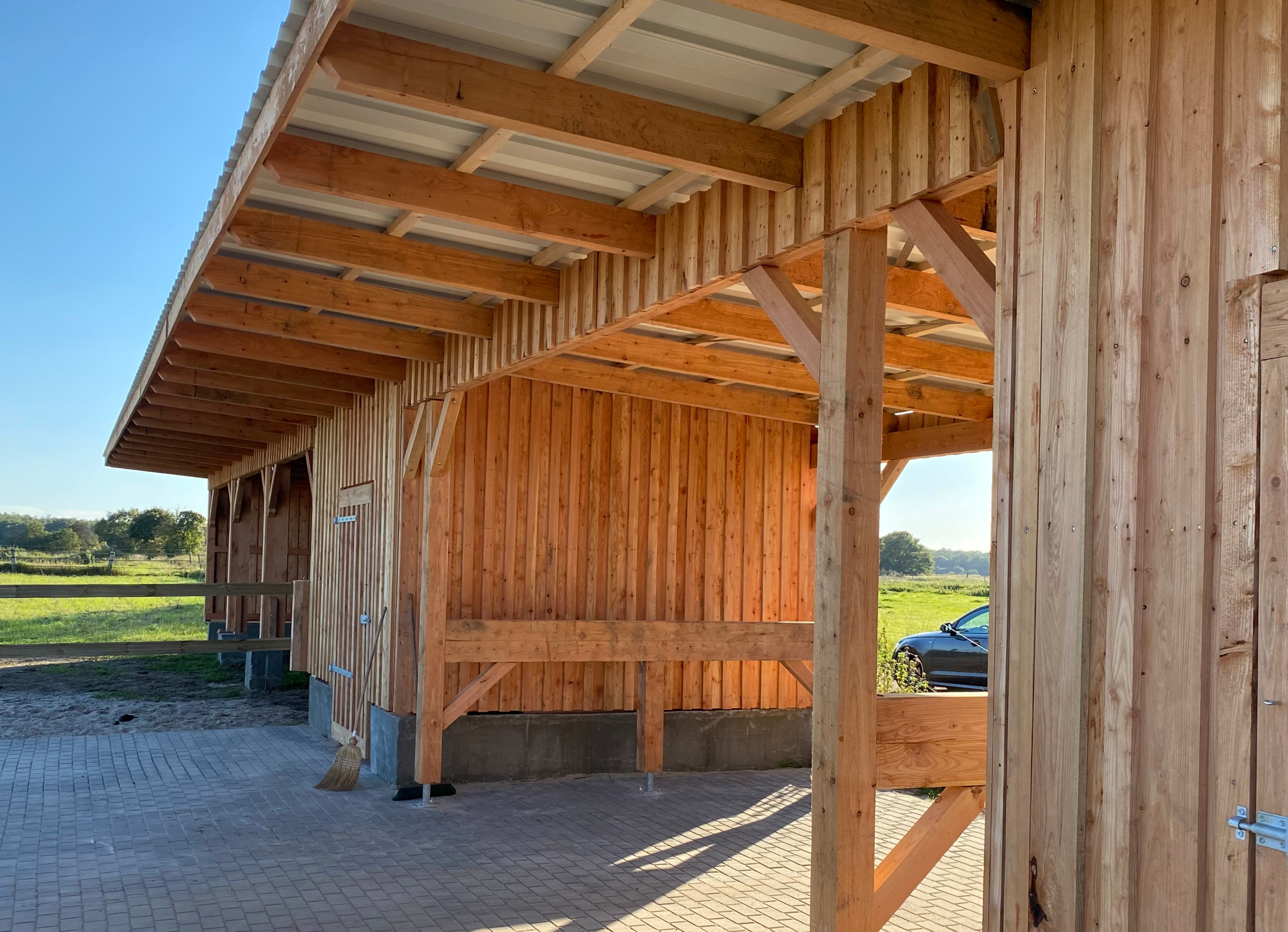
- The Eichhof Akademie runs 35 outdoor stalls (4 × 4 m, wood shavings) and four to five open stables in parallel — horses can switch between the two if they need to.
The question „open stable or stall for my competition horse?” gets debated in every riding forum — and is almost always decided in the wrong place. It’s rarely about the form, it’s almost always about the management behind it. Once you have grasped that, you start looking at yards differently.
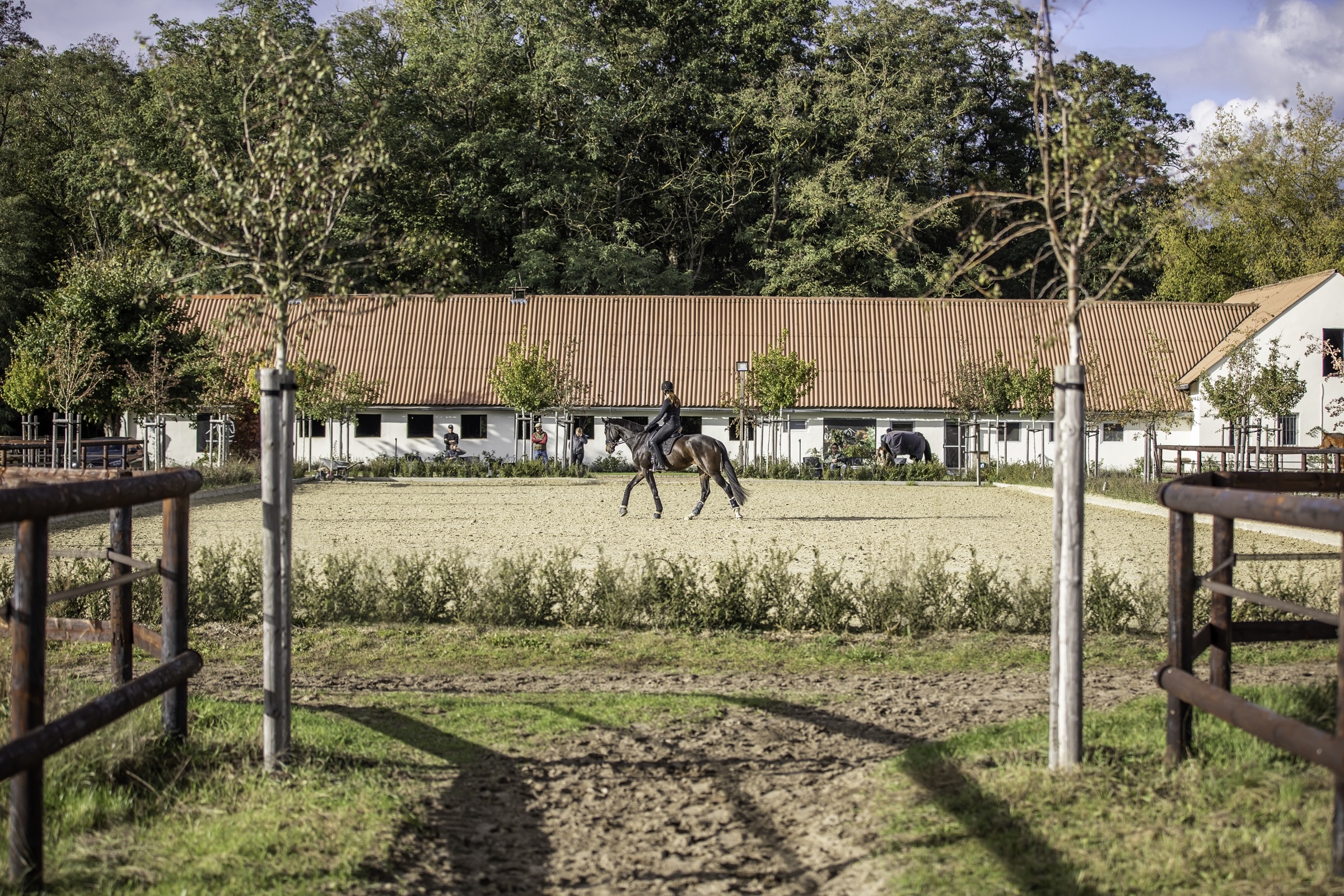
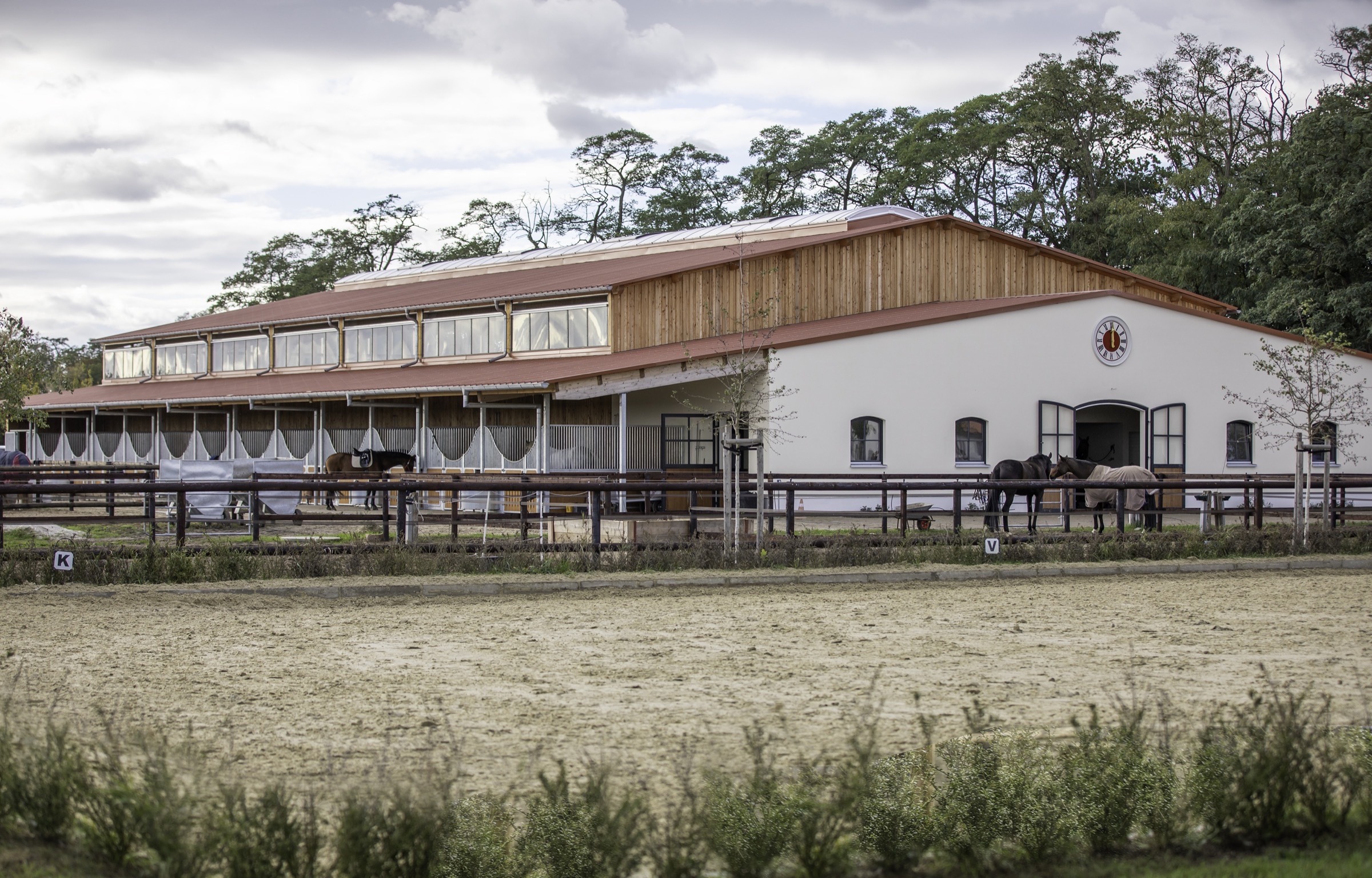
Both housing systems can keep a sport horse healthy and performance-ready in the long run — provided the management is right. Open stables score on free movement, social contact and better air quality. Outdoor stalls with shavings bedding offer controlled feeding, individual rest periods and protection from herd conflict. At Eichhof Akademie in Potsdam-Mittelmark we run both in parallel — 35 bright outdoor stalls and four to five open stables — and can switch between them when needed.
Below we clarify the prejudices that stick to the open-stable debate, what the science says about equine asthma, and how to recognise genuinely good housing — whatever its form.
The question is framed wrong
Riders think in categories: stall or open, classic or modern, sport or leisure. Horses think in needs: enough movement, social safety, clean feed, good air, a predictable daily rhythm. If those needs are met, the architectural form is secondary.
That is true even at the top of the sport. Several Olympic horses of the last twenty years have lived permanently in open stables — others were stalled but turned out four to six hours every day. Both routes work. What never works: 22 hours in a stall without social contact, with straw and poor ventilation.
That is the backdrop for our boarding near Berlin — we don’t see open stable and outdoor stall as opposites but as two tools that suit different horses.
Open stable: real benefits and realities for sport horses
The biggest plus of the open stable is banal and at the same time fundamental: the horse moves voluntarily. Walk is the gait that builds the most postural muscle and tendon elasticity, and a horse in the open stable does 8,000 to 12,000 steps per day — without anyone riding.
Concrete effects we see in practice:
- Fewer airway issues. Horses in open stables breathe primarily outdoor air. Hay-dust and ammonia concentrations are clearly lower than in closed barn aisles.
- More stable gastric health. Continuous hay availability prevents over-acidification — a known risk factor for gastric ulcers, found in up to 60 percent of horses in elite sport.
- Better baseline fitness. Horses who run free every day need shorter warm-up phases under the saddle.
Two realities also belong here, though: small injuries (scratches, kicks) are more common in open stables than in single stalls, and the daily workload is higher — muck volume, water checks, group monitoring. We solve this with homogeneous herds (geldings and mares separated), clear zoning in the turnout area, and an experienced yard team that knows the horses individually.
Outdoor stall as a middle ground: fresh air with control
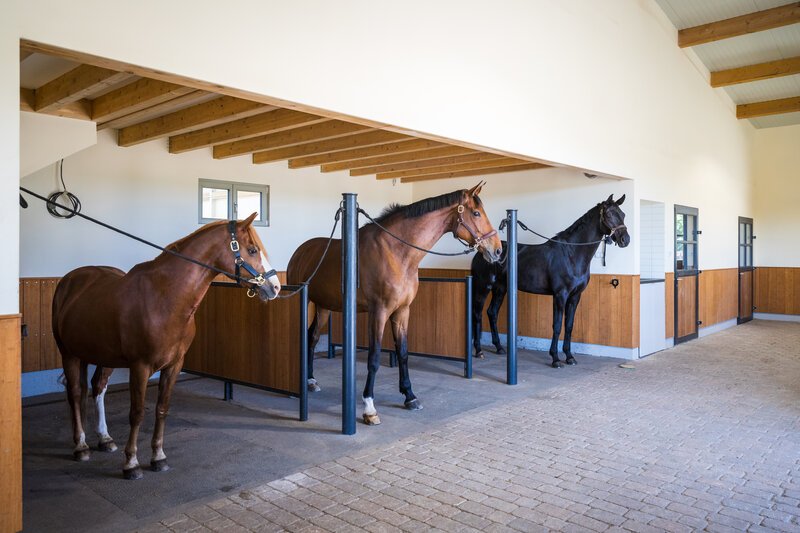
A modern outdoor stall is not comparable with the dim indoor stalls of the 1980s. Our 35 stalls at Eichhof Akademie are 4 × 4 m, bright, well-ventilated and freshly bedded with shavings every day. The horse has visual contact with neighbours but can be fed individually, gets paddock or pasture from 7:30 to 15:30, and spends the evening in a controlled, calm environment.
This form is often the better choice for:
- sensitive mares who feel stress at the herd’s pace,
- convalescing horses after tendon injuries who need controlled movement,
- horses with individual feed management (metabolism, EMS, Cushing’s),
- sport horses who need rest in single accommodation between competitions.
A note on terminology: „outdoor stall” is not the same as „indoor stall”. An indoor stall in a closed barn aisle is, from an airway perspective, not a better alternative to the open stable — it’s the worse one. „Outdoor stall” means stalls that ventilate directly to the outside, ideally with their own external door.
Equine asthma: the underrated factor
This is the point most often missing from the open-vs-stall debate. Equine asthma (formerly COB or RAO) affects, depending on the study, 14 to 80 percent of sport horses, often in the mild form that barely shows in daily yard life — until the horse starts coughing under saddle or performance drops off.
The triggers are well known:
- Straw bedding is prone to mould and produces high dust loads.
- Closed buildings with long aisles trap ammonia and hay dust.
- Hay of poor quality is the second most important trigger — especially when fed dry.
The protective factors are equally known: shavings instead of straw, open outdoor stalls or open stables, high-quality hay (or haylage), and long turnout in fresh air. This combination is the standard at Eichhof Akademie, not a premium add-on. Anyone buying a young horse and wanting to keep its airways healthy should clarify these four points before any kit question — before a pre-purchase exam and trial ride.
What matters more than the housing form: management
A yard is only as good as its daily routine. Whether stall or open stable, three things decide:
- Reliability. Are the horses fed, mucked and checked at the same time every day? Horses settle on routines.
- Observation density. Who notices that a horse ate less today? On large yards that information disappears easily.
- Training surfaces that work in winter. A yard with an ebb-and-flow indoor arena and a weather-protected turnout space can train consistently — regardless of housing form.
At Eichhof Akademie we walk the whole yard every evening around 8 pm. Every horse is seen, every trough checked. That sounds banal, but it is the difference between a yard where problems are noticed early and one where diagnoses come late.
How to make the right decision
The most honest answer is: try it with your specific horse instead of deciding theoretically. We show you the yard, look at your horse, and talk about its temperament, training load and history. Out of that mix comes the answer to whether the outdoor stall or the open stable suits better — and whether a later switch might be sensible.
If you are interested, contact us for a viewing. We take time, show both housing systems on site, and talk through what online comparisons can’t show: the horses themselves.
Open stable vs. outdoor stall at Eichhof Akademie
| Feature | Open stable | Outdoor stall |
|---|---|---|
| Movement budget | 24 h free + summer pasture | daily 7:30-15:30 paddock/pasture |
| Social contact | high, in homogeneous herd | visual contact with neighbours |
| Air quality | continuous outdoor air | outdoor stall + shavings, very good |
| Feed | continuous hay availability | individual mix with oats |
| Suited for | young, social, asthma-prone horses | sensitive horses, rehab, competition week |
| Injury risk | slightly higher (group) | very low |
| Price from | 500 € / month | 900 € / month |
Further reading
- Stall, paddock box, open stable, active stable comparison — all four forms of housing science-based
- Choosing a boarding yard: 12-point checklist — what really matters
- Stable change with horse: move and settling-in — when the current facility no longer fits
Questions & Answers